Showing posts with label Fiction. Show all posts

Wednesday, October 1, 2014

Maze Runner Review

Thomas and friends
What do you do when you don't know what to do?

Last night I went to see Maze Runner. The overarching plot, quite far fetched, can mostly be ignored. But the basic plot allows the viewer to wrestle with the questions of uncertainty and risk.

In the beginning of the film, we find ourselves introduced to the “Glade” and its inhabitants through the eyes of the new guy, Thomas. Thomas joins the “Gladers” by default because no one knows what is really going on. All they know is that they have no memories prior to their arrival there and that bad stuff happens all around them.

Gladers
Thomas, quickly learns that they have been living in fear and uncertainty but if they just keep their heads down, they are pretty safe. But safety isn’t Thomas’ highest priority. He wants more. He is willing to take risks to find answers and pursue freedom.

To me the haunting question the movie asks is, “What do you do when you don't know what to do?”

I know I tend to be like the “Gladers” who want to just stay put. They are the ones who want to hunker down and not take any risks - to do what seems safe rather than to boldly make decisions and changes that might go horribly wrong but also might lead to change good change.
Hong Kong Protesters 
But then I think of the people of Hong Kong. They would be safer at home, quietly doing what millions of Chinese do every day and just quietly allow the Communist Party leaders stack the deck and run the country pretending to have elections. But they want freedom. Thousands are standing up, like Thomas, and taking to the streets. They know there is a good chance that they will be hit with tear gas (or worse). But they are willing to take that risk. Freedom is worth it. Some risks are worth taking.

You can check out more reviews here!


Post by Jeremiah Lorrig


Tuesday, September 30, 2014

My Very Own Greek Myth


temple of hephaestus in athens
Greek Temple in Athens (Photo by Jeremiah)
So, today was a long day. Long days inspire me to want to mope around, watch TV, or sleep. But today was not only long, but it also included me sitting down and reading Romeo and Juliet (gotta love the classics…). So what happens when Jeremiah has a long day and reads Romeo and Juliet? He starts writing revisionist history.


Here is what I have so far:


In the days of ancient Greece, the Persians were planning to invade Greece (it had become a national pastime). So, they marshalled their forces, mounted their fiercest Rinos and Hippos and rode off to war. Then they hit the coast and remembered that there was a sea between them and the Greeks (you would think that they would remember this fact, after all, they invaded Greece all the time). So at that point they mounted their fiercest Rinos and Hippos and loaded them on some near by ships and rowed off to war.


This invasion, of course, was expected by the wise Greek philosophers in Athens. So they called the people together and told them that they should prepare for war. Now the people of Athens didn’t really like fighting; they prefered to sculpt and trade. So they decided to ask the brutish Spartans to help them in the upcoming war.


They wrote a letter that said,


“Dear Fierce Spartans,

battle of thermopylae
Spartan (Photo by Jeremiah)
Hope you are doing well. How did your pillaging go last week? We heard that you did great. By the way, we heard that you might be bored on Tuesday. Would you like to come over and beat up on some Persians? We are having the Corinthians over too, but you know they can be a little slow in battle. Pottery really is more of their thing.

Anyway, having you here would really liven things up.

Love, 
Your friends,
Fighting until the end,

Athens

P.S. BYOS (Bring your own shield)”


Then they realized that Ben Franklin hadn’t opened the post offices yet. That meant they needed a messenger. But no one volunteered. This may have been due to the fact that last summer a volunteer agreed to carry the message of victory from the battle of Marathon back to Athens. The problem was that no one thought to give him a horse (or even a hang glider!), so he literally ran himself to death. There was a series of long eulogies and every prophet worth his salt predicted that his run would go down in history as a tricky torture method that would lure people in and then slowly kill them. Little did they know that this would become a lucrative business because silly American’s would even pay to be victims of this Greek torture.


The bottom line was that no one wanted to run the all the way to Sparta. They offered a prize to any messenger and even promised that the runner’s family would be well taken care of. But somehow this didn’t help.


But the eagle flew overhead and everyone knew that the dogs of war had been loosed and the Persians weren’t going to sit around fiddling while Athenian ears burned because Egypt thought about them behind their back. So, the third most noble family in Athens offered whoever was to be the messenger a noble horse named Peg to ride while on this errand. Of course, the second most noble family couldn’t be outdone, so they offered a parasail (this turned out to be completely worthless, so they revised their offer to be a hang glider).  


The first most noble family was more than happy to let everyone else do all the work and pay for everything, so they didn’t offer anything at all.


That being settled, they found a youth named Peg who was willing to go. (Apparently Peg was a popular name for youths and horses in Athens.) What they didn’t know, however, was that this particular youth was wanted for pick pocketing in Corinth. He didn’t tell them because he needed the reward, but he wasn’t sure what to do (all roads lead through Corinth! ... well, all roads from Athens to Sparta lead through Corinth). Anyway, he decided not to tell anyone and that he would come up with something…


Once he was out of town, he started thinking hard. He had seen the philosophers on the Areopagus and they seemed to think that ideas came by the stroking of the beard. But he didn’t have a beard. The Priest’s in the Temple of Athena seemed to think inspiration came from owls. But he didn’t have an owl. So he was left to ponder his owlless, beardless, sad life.


But suddenly he had an idea. “Wisdom is a bearded owl!” But his excitement quickly faded, because that didn’t help him. What he needed was a beard, that way he could go through the city without being recognized. Wait! Maybe he was on to something!


“I shall use the wings of an owl to fly over the city!” he proclaimed. “I have a hang glider and a horse. I will attached the wings to the horse, and glide over the city and speed my journey to Sparta.”


He swiftly put his plan to action. It wasn’t easy, but he was a sharp boy. He did have to borrow some clothes lines for ropes and the contents of the clothes lines for extra cloth to make it work for a horse, but in the end it worked like a charm.


The people of Corinth saw him riding high in the sky and asked what it was that the gods had sent over their city. Peg, being honest (except for the pick pocketing), wanted to clear things up. So over the wind he tried to explain that he and the horse were not divine. He said with conviction, “We are just a couple of Pegs and the people of Athens have entrusted us to carry a message to Sparta.”


But to the people of Corinth it looked like a horse with wings. And the only words that they heard in the explanation were “Pegs” and “us.” To this day, the legend of a winged horse named “Pegasus” is told to children in Greece and American’s in Liberal Arts Colleges.


Pegasus 
The rest, my dear reader, of course is history that you are very aware of. But now, you know the origin of the Pegasus. I hope you will continue to tell the tale, and bring smiles to the faces of people in your life.


Post by Jeremiah Lorrig 

Saturday, April 5, 2014

Captain America: the Winter Soldier Review

Don’t get me wrong: in many ways I really enjoyed the movie. There were some great one-liners, solid character moments, and exhilarating action scenes.


In short, Captain America: the Winter Soldier was an adequate film.


What got me down is that this film confirmed my fear of recent years: the Golden Age of superhero movies has passed. Let me put it this way, if you were to set up a spectrum with Batman Begins on one end and the Green Lantern on the other, recent superhero films have fallen closer to Green Lantern.


Nolan and others in the last decade and a half wanted to make movies. That seems to have been their goal. They would then take characters and situations from comic books and put them in the movie, and the results would end up astoundingly powerful. They pulled in millions of people who never read the comic books and where not at all interested in “comic book movies” because they were making good film that happened to have comic book characters. Each of those films could be watched on it’s own (or in a short trilogy) and be enjoyed for what it was without any concern for the greater comic book world (because it took place in a world not too different from our own).


In the last few years the comic book movies seem to be more about the comic books. They are not putting those heroes in our world (or a similar one), but instead they have built worlds where the strange is normal.


In these worlds the directors don’t need to justify anything with explanation other than “that’s how it is in the comics.”


As much as I enjoyed the film, a part of me walked out of the theater resigned to the fact that I’ll still go see these movies, but I’ll be getting Green Lantern-like fantastical worlds, not a NYC that can’t decide what to do with something as strange as a guy in a spider costume who beats up baddies.


I guess this is an ode to those in the good old days who died and stayed dead: Uncle Ben, Rachel Dawes, and Ra's al Ghul. Your deaths where powerful and stayed powerful because you stayed dead.

Click here for more movie reviews.

Tuesday, April 30, 2013

The Hero's Guide

Ok, time for a little quiz. How many of these characters can you name?


Not difficult? I thought so.

Now for the hard part. How many of these characters can you name (and I mean real first names, not titles)?


Let's see, Shang, Flynn, humm, ummm, Prince..., Charming?, well..., I think..., Ha! Aladdin, and John Smith.

Exactly.

These guys go through life collectively known as "Charming." In fact, things have gotten so bad that no one knows their real names anymore. (Disney Wiki says they are, from left to right, Shang, Flynn, Adam, Eric, Ferdinand, Charming, Phillip, Naveen, Aladdin, & John Smith.) They are simply flat, interchangeable characters. They are called heroes, but, well, honestly, what heroics have they actually accomplished?

They need some help. They need to perform some real heroics.

Fortunately, unlike the lousy bards responsible for most of the above stories (and who forgot to even name the princes), Christopher Healy has written the "happily ever after" from their perspective. It's aptly called The Hero's Guide to Saving Your Kingdom.

In it, you'll meet the self-assured Prince Liam, the foppish Prince Frederic, the absent-minded Prince Duncan, and the muscular but insecure Prince Gustav (he has sixteen older brothers, each more muscular than he), as well as their respective princesses Sleeping Beauty, Cinderella, Snow White, and Rapunzel. This group has not only names, but also distinct personalities.


Unfortunately, what the princes don't have at this beginning of happily ever after, is princesses. You see, after the initial thrill of being in a fairy tale wore off, all the princesses discovered that their princes were rather, well, immature. So, by means of various happenstances, all four princes end up together, lamenting their troubles with their princesses.

Which is when danger strikes. And, as the title would suggest, they need to rise above their slights and save their kingdom (with the help, of course, of their princesses). Along the way they learn the importance of heroism and bravery, their princesses learn that they may have misjudged their princes to quickly, and we learn that not all the princesses were accurately portrayed either in the common tellings.

Not that this is a moralizing tale, however. It is tongue-in-cheek fairy tale in one of the best senses (right alongside Dealing with Dragons), and is full of giants, bandits, ruffians, witches, and kingdoms that need saving. And, as would be expected, this is only the beginning of their adventures. Because once the kingdom has been saved, we're ready for The Hero's Guide to Storming the Castle.

Click here for more book reviews.

Wednesday, February 13, 2013

The Strictest School in the World

Writing about Flavia de Luce’s adventures last week reminded me of another YA fiction book I read awhile back.

But when I sat down to write this review, I realized that the subtitle told you practically everything you needed to know.

After all, a title such as: The Strictest School in the World: Being the Tale of a Clever Girl, a Rubber Boy and a Collection of Flying Machines, Mostly Broken doesn’t leave all that much out.

(Except the pterodactyls. They somehow didn’t make it into the subtitle.)

Of course, should that not prove exciting enough, there’s always the (not quite as good but still intriguing) sequel.

Ready for it?


And the third (which I must admit to not reading, as it was not yet published when I read the first two).

Island of Mad Scientists, The: Being an Excursion to the Wilds of Scotland, Involving Many Marvels of Experimental Invention, Pirates, a Heroic Cat, a Mechanical Man and a Monkey

So there you have it. Yet another set of madcap adventures.


Click here for more book reviews.

Thursday, February 7, 2013

An incorrigible detective

Flavia de Luce is a normal 11 year-old living in England in the 1950s. She is tormented by her older sisters, in need of a mother, virtually ignored by everyone else, misunderstood, bright, and a legend in her own mind.

And she is an amateur chemist,

who lives with her Father (an ardent stamp collector) and two sisters (the aforementioned persecutors) in an ancient Victorian house,

and she has a passion for poisons,

and the habit of discovering dead bodies (no, they are not connected to her love of poisons—the worst she uses that for is to add the occasional skin irritant to her sister’s makeup kits).

Ok, so maybe she isn’t quite normal. But she wouldn’t have it any other way.

We first meet Miss de Luce in The Sweetness at the Bottom of the Pie, blindfolded and locked in a closet. How she got there, and how she escapes, are matters beyond the scope of this review. Needless to say, she does.

Only to discover a corpse in the cucumber patch, of all places.

She then strikes up a friendly rivalry with the local police Inspector Hewett, each trying to solve the case first. As the new corpse is tied to an old one, the case gets beyond what anyone initially imagined. (Were Inspector Hewett to be asked about the “rivalry,” he would likely wryly grin and characterize it as Miss de Luce getting in the way of the investigation. So it’s probably best we didn’t ask him.)

But then, Flavia has always been like that. The author Alan Bradley describes her thus:

"Like Athena, who sprang fully formed and fully armed from the brow of Zeus, Flavia simply appeared," the author says, speaking from his home in British Columbia. "She walked onto the page of another book I was writing, and simply hijacked the story. I had no idea who she was or where she came from, and because of that, I resisted her. It took Flavia a while to make me shut up and listen." 
More than hijacking the story, Flavia eventually forced the abandonment of the project. 
"I was working on another book set in the 50s about this young woman broadcaster on an exchange programme. I was well into it - about three or four  chapters - and as I introduced a main character, another detective, there was a point were he was required to go to a country house and interview this colonel," Bradley recalls. 
"I got him up to the driveway and there was this girl sat on a camp stool doing something with a notebook and a pencil and he stopped and asked her what she was going and she said 'writing down number plates' and he said 'well there can't many in such a place' and she said, 'well I have your's'. I came to  a stop. I had no idea who this girl was and where she came from, and I couldn’t get past that point until I sorted out who she was."
The author is now five books in with one more scheduled, and I’m still not sure he has sorted out exactly who this utterly precocious and incorrigible heroine is. Nor am I sure it’s even possible.

Saturday, May 19, 2012

Homeschool Fantasy: A Review of the Inheritance Cycle

Christopher Paolini’s Inheritance Cycle is a homeschooled kid’s fantasy. Yes, it has a youthful protagonist who stumbles upon an impossible yet predestined quest (stop the near invincible antagonist). Yes, it has swords and dragons and dragon lore. It has magic-wielding elves, fortune-telling herbalists, clans of dwarves, and even werecats. And in this four part epic story, there is also the fantastic fulfillment of an adolescent dream.

Paolini is hardly the first teenager, homeschooled or not, to write stories. Inspired by favorite stories or films, they concoct wild tales with less direction than finesse. If persistent, they construct outlines and draft a few tortured chapters. If bold, they share with family and friends. Their output, mercifully, is usually euthanized when the family computer expires and is replaced.

But Paolini was inspired, persistent, and bold. At an age when most kids are progressing from simple algebra to simple trigonometry he sketched a complete fantasy world, and with it the trajectory of the entire Inheritance Cycle. He then showed the draft of the first book, Eragon (with his parents, impressing them enough that they published it through their home business and launched a family book tour. The tour failed, but it did put Eragon in the hands of a published author, who passed it on to a big publishing house. After a full round of editing, Alfred A. Knopf re-published Eragon and turned it into a best seller.

Despite the success of Eragon (including a feature film) and the ensuing books, I found considerable criticism as I researched for this review. Some of it is justified; the writing is sophomoric at best and the storytelling suffers from this and other maladies of inexperience. My notes are laced with invective on these points. Since the author was indeed a sophomore when he did most of the writing, I decided not to share them.

Other reviewers complained that Paolini created his fantasy world by ripping off a dozen other authors, adding little to nothing of his own. This is a common complaint against even the greatest fantasy writers; only Tolkien seems to be sacrosanct when it comes to borrowing versus stealing. In this case, the charge sticks because the world he created is firmly standard fare. His elves are haughty, sylvan creatures who outdo humans in both physical and magical pursuits. His dwarves are suspicious metalworkers who build vast underground cities networked by tunnels. The boy Eragon develops predictably in line with the quest motif. But stock characters are what define genres. You can only do so much with an elf before he is no longer an elf. Few authors can transcend genre, especially in fantasy. Tolkien was ahead of his time and produced a revered classic. J.K. Rowling wrote something truly original that outgrew all the rest. And more recently, George R. R. Martin has used the genre to play a Hobbesian tune, reminding us that life is indeed nasty, brutish, and short.

For most authors, including Paolini, art begins with imitation. And most artists spend a lifetime with little progress. The best learn to combine the basic elements with some originality, or at least to put new twists on the techniques of their forerunners. Only the transcendent actually create something new - this is why Picassos only come along once or twice per generation. So to conclude Paolini’s defense, it is in fact remarkable that a boy of 15 could create such a robust story by applying imagination to imitation.

Despite the above complaints, the story itself is truly compelling. The quest motif may be formulaic, but that diminishes none of its appeal as a great element in human narrative. It is David against Goliath (except Eragon gets to ride a fire-breathing dragon and share her thoughts and powers). The reader rides along, with romantic and irrational love for the underdog suspending despair. Paolini treats one theme with a great deal of maturity, and that is the intersection of hope, fatalism, and prescience. Eragon knows that he must face the evil and powerful Galbatorix. He knows the odds. But he will not relent. He continues to search for ways to improve his skills and find some new advantage for himself and his dragon. As long as people maintain their belief that they can manipulate outcomes, hope springs eternal.


Eragon also discovers a tension he must navigate as his power increases. He finds he is not so different from young Galbatorix, whose power eventually consumed and corrupted him. Galbatorix is the product of unchecked nature; Eragon responds to nurture as the hour of need insists he become both a great man and a good man. This tension builds as the stakes increase. Early in the story, Eragon chastises his friend Murtagh for killing a brutish Urgal when it might have been avoided. By the end of the story, he routinely and dispassionately performs the cruel calculus of war to find the lesser evil. The power and responsibility harden him, making him more like the fiend he must defeat.

These are the strongest themes; otherwise, the series is quite ordinary. The action scenes and battles should be the strongest, but they are hamstrung by weak writing. The panoramic descriptions are likewise rich in precision but devoid of grandeur. Paolini fails to satisfyingly develop most of the major supporting characters, and he too often resolves conflicts between individuals and priorities with perfunctory arguments and tautological reasoning. When he tries to make profound observations on basic human problems, he sometimes succeeds, but other times falls flat. For example, when the rebel forces capture a key imperial city, Eragon glibly instructs them to give all the slaves a gold piece and set them free. There is no assimilation plan to back this noble sentiment, and it is never mentioned again. When the rebels move on two pages later, the slaves are left without vocations or any guarantee of safety, presumably at the mercy of their former masters. Any 8th grade student of American history knows that you cannot amend slavery in two sentences.

The Inheritance Cycle is best regarded as a few hours of light summer reading, exciting but not especially enriching. It is strictly a tale of adventure, imagination, and dragons. There is enough violence to deter the very squeamish (battles, physical suffering, even torture), but not enough romance to deter the young lads who will appreciate the story most (Eragon’s romantic pursuits are far less successful than his primary quest). As a young adult offering, it makes a great gateway from Tolkien, Lewis, and Pullman to the wider fantasy landscape. But although a gateway, it will not ultimately stand out much from the crowd. I could perhaps rank it in the top 12-15 fantasy series that I’ve read; it might drop to the 20s with enough introspection. (That is less an indictment of Eragon than a nod to how wide and densely populated that greater fantasy landscape is.) But as an introduction, it serves its purpose well. And with the Inheritance Cycle, Paolini begins what may be a very promising career as a writer.

By Daniel Archer. Daniel is a friend and former classmate of ours at Patrick Henry College.


For more of our reviews click here!

Thursday, March 29, 2012

Let the games...never end

This is Part II of our review of the Hunger Games. Part I is available here.

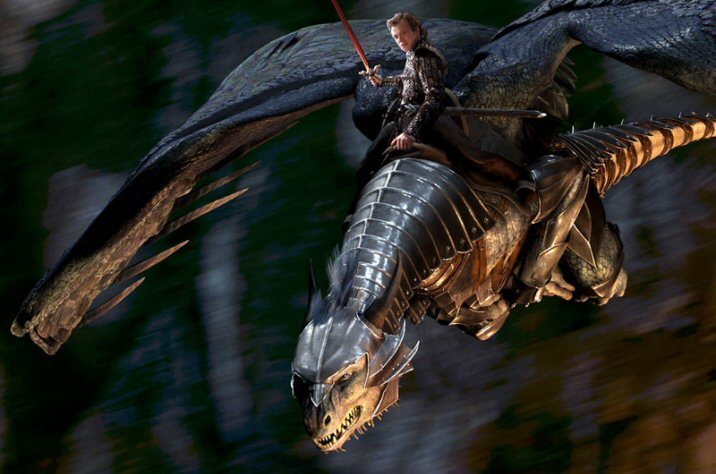
Book 1 of The Hunger Games trilogy ends with Katniss returning home victorious in the games by virtue of her defiance toward the Capital. According to tradition, the winners remain celebrities in their home districts, where every need is provided for the rest of their lives.

But Collins, and by extension the Capital, couldn’t be that nice. Besides, after the success of the first book, a sequel needed to be written. So the next year, instead of picking new competitors as was typical, the Capital called two prior winners from each district back to compete against each other. Yes, this means Katniss is in the games again.

Unfortunately, Collins exhausted her supply of plot in the first book. So in book two (Catching Fire), once again we have the journey to the capital, the parading in front of ecstatic fans, and the fight to the death in a booby-trapped arena. This time, however, because the reader is attached to more characters, Collins must find a different way to cheat the ending. A previously unmentioned rebellion and deus ex machina (literally - a helicopter swoops down and rescues a group of contestants) achieves that goal.

Book three (Mockingjay) then follows Katniss’ involvement in the ensuing rebellion. Apparently, and previously unknown to her, she is some sort of a figurehead in the effort to overthrow the Capital. However, her former independent spirit and resourcefulness have largely disappeared and she is reduced to pawn in the rebellion. Intent on not being used by the Capital, she is instead used by the rebellion.

And, true to the formulaic pattern of the books, she again faces a booby trapped arena in the form of the Capital itself, which she must navigate street by street with a few loyal followers intent on killing the Capital's president out of revenge. This time, however, the brutal ending is not cheated. Many people are killed, and others disappear, as the Capital falls. By the end Katniss realizes that the rebellion she is fighting for is just as bloodthirsty as the Capital she helped overthrow. Only in the epilogue is she finally recovering--sort of. She returns to her original district and tries to piece a life back together.

So with that synopsis, let’s turn to the analysis.

First, as was probably evident from my intro, Collins’ second two books suffer from a severe lack of new story. And while a repetition model can sometimes work when it is clearly part of a larger plan (such as concentric plot circles, each level bigger to the previous one), that’s not the case here. Collins’ story is still highly engaging, and the reader is rushed along desperate to find out how it ends. But the reader also gets the sense that the author herself doesn’t know where she’s going, so she is simply circling back to kill time while she tries to find a satisfactory ending. Except that Collins has boxed herself into a corner that she is unable to write out of.

The second striking observation is Collins’ apparent increasing disillusionment with Katniss. While she is a strong character (even possibly a role model) in the first book, the second and third books are more about her fall than about the fall of the Capital. There are plenty of other engaging and sympathetic characters, but Katniss is not counted among them. Instead, most of the endearing qualities she had in the first book are shed as she becomes a drugged machine blindly set on revenge. Although the story is told from her perspective, she is increasingly detached and her judgement is clouded.

Which brings me to my next point. The love triangle. Yes, I neglected to mention it in my first post, but in books 2 and 3 it becomes a more central plot point as Katniss’ childhood friend/hunting buddy Gale and her co-competitor from the first games Peeta vie for her heart. In a way, they each represent a part of her dual personality. Gale matches her militant tomboy side, while Peeta reflects her desire for peace and a home. As Gale and Peeta become more and more defined, her personality traits also diverge, leaving her a psychological wreck. She must choose between the two of them, and how she chooses will affect who she is.

So what do we dowith the Hunger Games? In a way, as I argued in the first part of my review, they serve as a profound reflection upon today’s society and the direction it is heading. Book 1 especially made that point clear. But as she kept writing, Collins lost sight of that goal. Rather than critiquing that culture, she bought into its propaganda--pushing the spectacle further and further with more and more gratuitous and senseless deaths. She may be trying to object to a meaningless system of power, but she has nothing better with which to replace it.

Book one ended with Katniss defying the Capital and returning home. Book three also ends with Katniss at home, but this time she is trying to piece together what is left of her psyche and still playing games in her head.

The Hunger Games may be over. The Capital may have fallen.

But the games won.

________
Related articles:
Review of Hunger Games Book 1
Review of Hunger Games Movie

Monday, March 5, 2012

The Hunger Games, part 1

Based on popular request, Looking for Overland:YE Speak is beginning book reviews of young adult fiction. A poll on our Facebook fan page showed that The Hunger Games was by far the book receiving the most interest. Book one is reviewed here and the second two are reviewed together in a subsequent post.

Author Suzanne Collins has stated that she was prompted to write The Hunger Games, in part, after channel surfing one evening and finding footage of military conflict and reality TV on two neighboring channels. The resulting story, consistent with that juxtaposition, is torn between entertainment and horror; it serves as a sobering commentary on our current culture.

But Collins’ inspiration runs deeper. She was also inspired by the Greek myth of Theseus. According to legend, King Minos punished Athens by taking seven youths and seven maidens every seven years to be fed to the Minotaur. One year Theseus, whose sister was among those chosen, volunteered. He successfully navigates the labyrinth, kills the Minotaur, and rescues his sister.

Collins takes this basic plot and sets it in Panem, a post-apocalyptic North America divided into thirteen districts governed by a central decadent capital city. But this is no Percy Jackson retelling; it is much more grim. The story begins sometime after district thirteen rebelled and was destroyed. Ever since the rebellion the capital reasserts its authority by taking two children each year, one boy and one girl between 12 and 18, to compete in the Hunger Games - a nationally-televised fight to the death in a multi-acre deadly obstacle course. The competitors battle each other, the elements, and the arena itself, until only one remains alive. Should the games get to boring over their multi-day span, the game designers can always create a flood or rain down fire to get the excitement going again.

The story is told from the perspective of Katniss Everdeen, who volunteers for the games in place of her younger sister. She then must navigate the celebrity culture that comes with being a contestant, parading before people impatient to watch her kill or be killed. She is a commodity—a piece of entertainment to them. Once the games begin, the book transforms into a survival story. It is so well told that the reader can even forget that the entire arena is contrived. That is, until the game designers make changes—jarringly reminding the reader of the cruel reality. Katniss must constantly determine how far she will go with the games, and how even through her forced compliance she can expose them for the evil they are. Ultimately, in a final act of defiance, she is able to win the crowd and make even the game designers relax their last rule.

The storytelling itself is a gripping first-person narrative which readers have difficulty putting down. I think I read it in virtually one sitting, and I know I’m not the only one to do so. It’s fast-paced, engaging, and thrilling. Readers can’t help but sympathize with the children and hate those who force them to fight. But at the same time, Collins also develops a sympathy for the citizens of the capital, who cannot see what they are doing. While not classic literature, The Hunger Games weaves these various themes together into a compelling story.

But it is also haunting and disturbing, which makes it complicated to analyze. On the one hand, it’s a story of a young heroine overcoming great odds and defying an oppressive system. There is much to be commended in both Katniss’ selfless devotion to her sister and her unwillingness to play by the contrived rules. On the other, it’s child gladiatorial combat with its fair share of gruesome details.

I’ve determined that it’s best read as a satire of our culture: it appeals to both our search for heroism and our willingness to be entertained by others’ suffering. The Hunger Games exposes and bridges that gap. That, I think is the book’s greatest strength. Through Katniss’ eyes Collins makes the reader experience the horrific consequences of seeking entertainment above all else. And by drawing readers into the thrill of the games, rather than letting them remain passive observers, Collins is able to show rather than merely tell, the thrill of the games. The readers themselves participate in both the rebellion of Katniss and the guilty pleasure of the audience.

But this is also the greatest cause for concern because I fear that not all readers realize how drawn in to the story they become. They won’t realize that it is satire. Instead, much of the fan base seems to have been caught up in the games, just as the citizens of Panem were. Because of this, I would not recommend the book to pre-teens or young teens, however older more discerning teens may still benefit from reading it so long as they were able to see how it reflects our culture. As a rule of thumb for parents, if you would let your child read Lord of the Flies, they could handle The Hunger Games.

* * *

In less than a month, the movie rendition of the the first book is being released. Across North America, millions of people will gather together before a screen watching children fight and kill each other in gladiatorial combat on a contrived set. The lighting will be perfect. Their makeup will be pristine. The effects will be inspiring. We will vicariously participate in Katniss' protest while at the same time demanding that the show go on.

We are Panem.

Related Posts Plugin for WordPress, Blogger...