Thursday, March 29, 2012

Let the games...never end

This is Part II of our review of the Hunger Games. Part I is available here.

Book 1 of The Hunger Games trilogy ends with Katniss returning home victorious in the games by virtue of her defiance toward the Capital. According to tradition, the winners remain celebrities in their home districts, where every need is provided for the rest of their lives.

But Collins, and by extension the Capital, couldn’t be that nice. Besides, after the success of the first book, a sequel needed to be written. So the next year, instead of picking new competitors as was typical, the Capital called two prior winners from each district back to compete against each other. Yes, this means Katniss is in the games again.

Unfortunately, Collins exhausted her supply of plot in the first book. So in book two (Catching Fire), once again we have the journey to the capital, the parading in front of ecstatic fans, and the fight to the death in a booby-trapped arena. This time, however, because the reader is attached to more characters, Collins must find a different way to cheat the ending. A previously unmentioned rebellion and deus ex machina (literally - a helicopter swoops down and rescues a group of contestants) achieves that goal.

Book three (Mockingjay) then follows Katniss’ involvement in the ensuing rebellion. Apparently, and previously unknown to her, she is some sort of a figurehead in the effort to overthrow the Capital. However, her former independent spirit and resourcefulness have largely disappeared and she is reduced to pawn in the rebellion. Intent on not being used by the Capital, she is instead used by the rebellion.

And, true to the formulaic pattern of the books, she again faces a booby trapped arena in the form of the Capital itself, which she must navigate street by street with a few loyal followers intent on killing the Capital's president out of revenge. This time, however, the brutal ending is not cheated. Many people are killed, and others disappear, as the Capital falls. By the end Katniss realizes that the rebellion she is fighting for is just as bloodthirsty as the Capital she helped overthrow. Only in the epilogue is she finally recovering--sort of. She returns to her original district and tries to piece a life back together.

So with that synopsis, let’s turn to the analysis.

First, as was probably evident from my intro, Collins’ second two books suffer from a severe lack of new story. And while a repetition model can sometimes work when it is clearly part of a larger plan (such as concentric plot circles, each level bigger to the previous one), that’s not the case here. Collins’ story is still highly engaging, and the reader is rushed along desperate to find out how it ends. But the reader also gets the sense that the author herself doesn’t know where she’s going, so she is simply circling back to kill time while she tries to find a satisfactory ending. Except that Collins has boxed herself into a corner that she is unable to write out of.

The second striking observation is Collins’ apparent increasing disillusionment with Katniss. While she is a strong character (even possibly a role model) in the first book, the second and third books are more about her fall than about the fall of the Capital. There are plenty of other engaging and sympathetic characters, but Katniss is not counted among them. Instead, most of the endearing qualities she had in the first book are shed as she becomes a drugged machine blindly set on revenge. Although the story is told from her perspective, she is increasingly detached and her judgement is clouded.

Which brings me to my next point. The love triangle. Yes, I neglected to mention it in my first post, but in books 2 and 3 it becomes a more central plot point as Katniss’ childhood friend/hunting buddy Gale and her co-competitor from the first games Peeta vie for her heart. In a way, they each represent a part of her dual personality. Gale matches her militant tomboy side, while Peeta reflects her desire for peace and a home. As Gale and Peeta become more and more defined, her personality traits also diverge, leaving her a psychological wreck. She must choose between the two of them, and how she chooses will affect who she is.

So what do we dowith the Hunger Games? In a way, as I argued in the first part of my review, they serve as a profound reflection upon today’s society and the direction it is heading. Book 1 especially made that point clear. But as she kept writing, Collins lost sight of that goal. Rather than critiquing that culture, she bought into its propaganda--pushing the spectacle further and further with more and more gratuitous and senseless deaths. She may be trying to object to a meaningless system of power, but she has nothing better with which to replace it.

Book one ended with Katniss defying the Capital and returning home. Book three also ends with Katniss at home, but this time she is trying to piece together what is left of her psyche and still playing games in her head.

The Hunger Games may be over. The Capital may have fallen.

But the games won.

________
Related articles:
Review of Hunger Games Book 1
Review of Hunger Games Movie

Tuesday, March 27, 2012

United Nations supports parental rights!

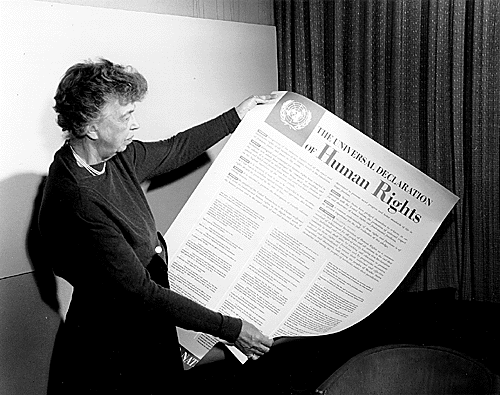
Or at least it did, in its own way, in 1948. Article 26 of the Universal Declaration of Human Rights addresses education:
(1) Everyone has the right to education. Education shall be free, at least in the elementary and fundamental stages. Elementary education shall be compulsory. Technical and professional education shall be made generally available and higher education shall be equally accessible to all on the basis of merit. 
(2) Education shall be directed to the full development of the human personality and to the strengthening of respect for human rights and fundamental freedoms. It shall promote understanding, tolerance and friendship among all nations, racial or religious groups, and shall further the activities of the United Nations for the maintenance of peace. 
(3) Parents have a prior right to choose the kind of education that shall be given to their children.
Read section 3 again. “Parents have a prior right to choose the kind of education that shall be given to their children.” What does that mean? Exactly what it says. States should not compel public school attendance.

Johannes Morsink, professor or of Political Philosophy at Drew University, explains the history of that very provision in his book The Universal Declaration of Human Rights: Origins, Drafting, and Intent.
Article 26 (on education) is one of the articles most clearly shaped by the experience of [WWII]. This article has three paragraphs, a nuts-and-bolts paragraph that is a standard constitutional item, a goal-and-purpose paragraph, and a paragraph that gives parents a prior right in deciding what kind of education their children shall have. The second and third paragraphs were put in the article as a way of condemning what Hitler had done to Germany’s youth and of making sure that it would never happen again…. 
The War Crimes Report that the Secretariat had drawn up for the Human Rights Commission explained to the delegates, as if they needed to be told, that “‘in order to make the German people amenable to their will and to prepare them psychologically for war,’ the Nazis reshaped the educational system and particularly the education and training of German youth, imposed a supervision of all cultural activities, and controlled dissemination of information and the expression of opinion within Germany as well as the movement of Intelligence of all kinds from and into Germany.” The second and third paragraphs of Article 26 were written in direct reaction and opposition to this Nazi abuse of state power. Paragraph 2 of the article states: “Education shall be directed to the full development of human personality and to the strengthening of respect for human rights and fundamental freedoms. It shall promote understanding, tolerance and friendship among all nations, racial or religious groups, and shall further the activities of the United Nations for the maintenance of peace.” 
The first draft of Article 26, paragraph 2 was placed on the drafting table by Bienfiled of the World Jewish Congress because his organization felt that there was a need to spell out both the goals and the spirit of educational institutions so as to avoid all kind of brainwashing the Nazi state had engaged in. Article 26’s third paragraph was added for the same reasons. Both the Dutch and the Lebanese delegations submitted amendments about parental rights. It being the shortest one, the Lebanese amendment was adopted after a vigorous discussion. The defense again was that the Nazis had usurped the prerogative of parents when they demanded that all children enroll in poisoned state-controlled schools, the paragraph was especially necessary because the word “compulsory” had been used in the first paragraph. [internal citations omitted]
Now, of course, care must always be exercised when dealing with international documents of this nature. States are sovereign entities, and thus, are and ought to be wary of any international institution telling them how to treat their citizens. Recognizing that, the UN Declaration is not a treaty and is not directly binding international law. It was drafted and intended to be aspirational.

However, as a moral and aspirational document, the UNDHR carries great weight in our post WWII world. That it took the time to protect parents’ rights to select the education of their children, in direct and intentional response to a state forcing children into the public schools, is a huge statement.

Sunday, March 25, 2012

Hunger Games Movie Review


I am one of the people who participated in making Hunger Games movie opening weekend the third highest grossing of all time (it might be higher when all the chips are in). So far according to BoxOffice Mojo it has brought in 155 million dollars.

Hunger Games is carried by great actors, solid effects, and a compelling story, yet it is limited by insufficient time to connect with the characters and a stupid audience. It is a loyal adaptation of the book (see our review here). It is PG-13 because of the heavy themes and violence. Hunger Games book is a cautionary tale about the dangers of desensitizing ourselves to violence and the shallowness of appearances. Furthermore it is a story of self-sacrifice for family and being willing to put the safety of the one you love before your own safety.

These themes come through in the film. When the main character Katniss sees her sister being forced to the front of the crowd as the “tribute” who must go to the Hunger Games, Katniss steps forward and volunteers to go instead.

The music cuts out, the world hurries by, and although you know what is going on around you, it is hard to believe it is happening. This scene captures the whirlwind feeling that one often experiences when life spins around you.

Another powerful scene is when one of the main characters admits that he loves someone and in the next breath why he will have to die for her. Once again they allow the moment to hang without music or effects and the sadness of the moment grips the viewer.

The acting, especially Stanley Tucci, was great. Tucci nailed the part of a news anchor and held the story together. Josh Hutcherson was almost typecast and fits the roll so well that I cannot imagine another actor taking that part. Both of them built an atmosphere that allows the viewer to engage the story for what it is and not be held back because of the foreign nature of the setting.

I was very disappointed in the audience and was reinforced in my belief that this is not a story for children. This is why: the children who were there showed their ignorance of the meaning. The story is about how horrible it is to have a society that embraces violence so much that it finds joy in kids killing kids. Twice during the film when a kid was killed they started applauding. I fear that in many ways Suzanne Collins’ world might very well be our own.

All told it is neither a great movie or a bad movie. It is powerful and deep. You may learn more about yourself watching it, or you may learn that our culture is not far removed from the culture of Panem. "Panem" is Latin for bread, a nod to the "bread and circuses" of the Roman empire. Depending on who is watching, Hunger Games is either a warning against building Colosseums or it is a Colosseum where you can watch the brutality of humanity while cheering and picking favorites.

Our culture hangs in the balance and the ods do not look like they are in our favor. 


Post by Jeremiah Lorrig
 

________
Related articles:

Friday, March 23, 2012

Friday miscellaneous (3/23)

Orson Scott Card gives a good analysis of the transformation of stories from book to film. Sometimes it’s done well, often not. Here’s why.

The Colorado legislature’s Planned Parenthood resolution got crashed by an unexpected visitor.

Romney, unlike Santorum or Gingrich, is running a debt free campaign. That’s good. But then Romney’s Communications Director compared him to an etch-a-sketch. That’s bad.

One of our readers pointed to what he calls the “biggest non-article of the campaign cycle”. I think he’s right.

Dr. Mark Mitchell contrasts patriotism with exceptionalism.

This is an amazing story about President Obama’s friendship with pastor Joel Hunter.

In an age where bankers seem to be both running and undermining our economy, it’s refreshing to hear of banks actually focusing on helping their community rather than just expanding.

Nicholas Kristof responds to those attacking the Kony 2012 effort.

Edmund Burke, often called the father of conservatism, was a harsh critic of liberal democracy. Is his critique warranted?

Burke’s prime reason for objecting so strenuously to democracy is as plain as it is compelling: democratic governance represents for him the exaltation of will above reason.  That it is the people’s will rather than the monarch’s which is thus exalted does nothing to mitigate the arbitrariness of such rule.

In Texas, an atheist threatened to sue over a nativity display at the courthouse. That party of this story is not unique. The part that is, however, is what changed his mind.

And finally, I think we can all agree that Romney needs more lines like this. Especially if/when he runs against Obama.

Tuesday, March 20, 2012

Alexis de Tocqueville on modern liberalism and conservatism

Thought for the day from Alexis de Tocqueville’s Democracy in America.
I perceive virtuous and peaceful men whose pure mores, tranquil habits, ease, and enlightenment naturally place them at the head of the populations that surround them. Full of a sincere love of their native country, they are ready to make great sacrifices for it: nevertheless they are often found to be adversaries of civilization; they confuse its abuses with its benefits, and in their minds the idea of evil is indissolubly united with the idea of the new.
Nearby I see others who, in the name of progress, striving to make man into matter, want to find the useful without occupying themselves with the just, to find science far from beliefs, and well-being separated from virtue: these persons are said to be the champions of modern civilization, and they insolently put themselves at its head, usurping a place that has been abandoned to them, but from which they are held off by their unworthiness.
Where are we then?
Men of religion combat freedom, and the friends of freedom attack religions; noble and generous spirits vaunt slavery, and base and servile souls extol independence; honest and enlightened citizens are enemies of all progress, while men without patriotism and morality make themselves apostles of civilization and enlightenment!
Have all centuries, then, resembled ours? Has man, as in our day, always had before his eyes a world where nothing is linked, where virtue is without genius and genius without honor; where love of order is confused with a taste for tyrants and the holy cult of freedom with contempt for law; where conscience casts only a dubious light on human actions; where nothing seems any longer to be forbidden or permitted, or honest or shameful, or true or false?
Notice how he looks first to the conservatives, then the liberals, and finds both wanting. His conclusion, though, although written in 1835, still describes modern society.

War in Iraq

I am currently reading Condoleezza Rice's book, No Higher Honor. It is a fascinating view into how national security works and what happened on that side of things during the Bush years including the September 11th terrorist attacks.

It was today, March 20th, in 2003 that the United States and three other countries began military operations in Iraq in the early hours of the morning.

It is remarkable what has changed since. Specifically, that the highest profile world dictator has faced justice. Saddam Hussein was the most feared and brutal world leader in the last several decades. Now he is gone.

I remember before the war reading a British intelligence report about the horrors that Hussein committed. Even to this day, I cannot even bear to write them down because of the horrific nature of the eyewitness accounts against political prisoners, women, and anyone who fell into the disfavor of the tyrant.

Hussein was brought to justice because of the bravery and sacrifice of men and women in the United States Armed Forces.

There is a line in the Battle Hymn of the Republic that many of us have always song as follows:

"As He died to make men holy, let us live to make men free!"

But that is not how it was originally written. It originally said:

"As He died to make men holy, let us die to make men free!"

That is a huge part of what has made America great. Good people are willing to live and die for others. I am thankful for my brothers (one in the Army and one in the Air Force) for being examples to me of good men who stepped up to serve their country.

We like to use dates to mark important things. We remember people we love by marking their birthday. We celebrate holidays for the same reasons. Let us make use of this day as well.

Let us remember this anniversary in two ways:
1. Remember that the world is changed for the better without Saddam Hussein.
2. Remember those in uniform with a prayer and a hug (if you can).


By Jeremiah Lorrig
Related Posts Plugin for WordPress, Blogger...