Showing posts with label culture. Show all posts

Tuesday, March 10, 2015

Did Republicans Lose the Culture War?

Several months ago the Politico published an article called: How Republicans Lost the Culture War. I have been thinking about it and although I think the author is very right that the “Culture War” is a loss and has been doomed for at least 5 years, I do, however, think he overstates his case. I know my thoughts might be controversial, and I would be happy to dialogue in the comments, just keep it civil. 

So here are my thoughts on the "Culture War" and what the future looks like from here: 

For the last three or so decades many in the Republican base have been motivated by what has been called the "Culture War." They have trained foot soldiers to engage the enemy, they have mobilized voters on key issues, and they have rallied their troops time and time again to "defeat evil." But despite all that, the culture war has been lost. Politico is just one example of a post-mortem of the war. Long standing warriors have told me that they are tired of it; millennials are refusing to fight; and we are constantly being told that history is against us.

But there is more to it than that.

The loss of the “culture war” doesn’t equal loss on issues like abortion. The pro-life position, even with the culture war faux pas, is gaining ground. Legislators and political activists are fumbling the ball, but the hearts and minds are moving our way.

Republicans are desperately trying to figure out birth control because Santorum walked it out in front of people and believes it is all wrong and Romney didn’t know what to say because he is a bit of a squish on the topic, but that doesn’t mean the GOP is going to lose on the issue of making everyone pay for abortions.

The Politico author appeals to the “march of history” to show that the GOP is doomed on social issues. The fact is that only works if you accept the progressive approach to history where everything is marching slowly toward their socialist utopia. But they don’t know history. The fact is that slavery, racism, acceptance of various sexual practices, and even abortion have come in and out of style (and law) over the centuries. Just because a “culture war” is lost, doesn’t mean that political choices are set in stone.

The reason I believe the “culture war” is lost is not because of unartful politics, it is lost because the “foot soldiers” think it is stupid. Most rank and file conservatives (especially conservative Christians) think that politics is the wrong way to change hearts and minds. Many, like me, reject the idea that they are supposed to be soldiers in a “culture war” and would rather focus on helping real, purhaps lost, people.

Young people today are more likely to want to volunteer at a pregnancy resource center than protest at an abortion clinic. Young people are more likely to try to show the unconditional love of Jesus with gay friends than try to outlaw their lifestyle. Young people have told me that they don’t want to be bullets in a “culture war.” They would rather lose the “war” than lose sight of their real goals, caring for people and sharing unconditional love.

In the end, the “culture war” is a failed project, but not because it was defeated politically, but because it was abandoned by those expected to fight it. Those who still are trying to keep it alive are out of touch.

Does the loss of the "culture war" mean that Christians, conservatives, and Republicans (three groups that I associate myself with), are giving up on making a difference in the culture? No, it just means that the culture isn't a battleground, it is a place where we must be salt and light, where truth must be spoken in love, and where hurting people are desperately in need of hope.

How do we translate this new phenomenon into a new political world? How do we end abortion in America and save lives? Conservative stalwart Morton Blackwell has said countless times,
"people don't care how much you know until they know how much you care." I think that applies to good laws. They wont be changed until people see that we care.

I believe that abortion will be abolished in my lifetime, but it wont be because we hate abortion doctors. It will be because people see that we love people and that includes both the baby waiting to be born and the mom struggling with life.

For a Christian, if there is a conflict, it is not against flesh and blood, but against powers and principalities, beyond this world. But what is hanging in the balance? Nothing less than the lives of those who need true, unconditional, empowering love. Seeing those lives changed by love is worth losing a dozen culture wars.

Post by Jeremiah Lorrig

Monday, February 16, 2015

Best George Washington Quotes

George Washington by Gilbert Stuart
Today is Presidents Day and therefore George Washington's birthday. In honor of the day, I have compiled my favorite quotes attributed to America's first president. I hope you can appreciate the wisdom here and are inspired by this great man.

----------------------------------------------------------------

“I hope I shall possess firmness and virtue enough to maintain what I consider the most enviable of all titles, the character of an honest man.” ― George Washington

Be courteous to all, but intimate with few, and let those few be well tried before you give them your confidence. - George Washington


True friendship is a plant of slow growth, and must undergo and withstand the shocks of adversity, before it is entitled to the appellation. - George Washington


Let your heart feel for the afflictions and distress of everyone, and let your hand give in proportion to your purse. - George Washington


I walk on untrodden ground. There is scarcely any part of my conduct which may not hereafter be drawn into precedent. - George Washington


Washington Crossing the Delaware by Emanuel Leutze
“To encourage literature and the arts is a duty which every good citizen owes to his country.” ― George Washington


“Real men despise battle, but will never run from it.” ― George Washington


“Be not glad at the misfortune of another, though he may be your enemy.” ― George Washington


George Washington by Robert Field
“The hour is fast approaching, on which the Honor and Success of this army, and the safety of our bleeding Country depend. Remember officers and Soldiers, that you are free men, fighting for the blessings of Liberty -- that slavery will be your portion, and that of your posterity, if you do not acquit yourselves like men.” ― George Washington


“I had rather be on my farm than be emperor of the world.” ― George Washington


“LIBERTY, when it begins to take root, is a plant of rapid growth.” ― George Washington


Truth will ultimately prevail where there is pains to bring it to light. - George Washington


It may be laid down as a primary position, and the basis of our system, that every Citizen who enjoys the protection of a Free Government, owes not only a proportion of his property, but even of his personal services to the defense of it. - George Washington

While we are contending for our own liberty, we should be very cautious not to violate the rights of conscience in others, ever considering that God alone is the judge of the hearts of men, and to him only in this case they are answerable. - George Washington

Signing of the Constitution by Howard Chandler Christy
Post by Jeremiah Lorrig

Wednesday, April 30, 2014

Final "Solutions"

I recently had the opportunity to visit the Holocaust Museum in Washington DC. It was a sobering experience and, combined with  Holocaust Remembrance Day earlier this week, prompted me to write something.

Two things in particular struck me about the museum. Whether these are related to each other or not, I'll let you decide. I'll simply present them.

US Holocaust Memorial Museum
First, the phrase "Final Solution," the Nazi description of their genocide, made sense in a way it never has previously. I knew it was the euphemism for the mass execution of the Jews, but it seemed a strange choice. The Museum gives the necessary background. In the literature prior to and leading up to the war, there were increasing references to the "Jewish problem" or the "Jewish question." Hitler, in particular, jumped on and perpetuated this way of thinking, emphasizing the problem. Segregation, ghettos, ostracization, deprivation of rights, concentration camps, were then all implemented with increasing severity to address this problem. It then made linguistically sense to refer to mass extermination as the "final" solution to the problem. There's a perverse logic to the whole thing. Once the premise of a "problem" was adopted, all sorts of "solutions" became viable. The euphemism was twice removed, allowing the participants to distance themselves from the horror they were committing.

I wanted to intervene in history and challenge the premise. What if Jews living among Germans isn't a "problem" that needs a "solution"? What if it is something else? The tragedy was possible because a "problem" had been misidentified.

And then I turned that on myself. What do we, do I, misidentify as a "problem" today? I can't change history, but here and now, where does a "problem" need to be challenged so as not to lead to an atrocious "solution." Where have people been labeled "problems" by their mere existence?

temp
US Holocaust Memorial Museum
What if the immigrant without documentation is a person, not a "problem"?

What if the unborn child is a person, not a "problem"?

What if the poor family taking advantage of assistance are people, not a "problem"?

What if in calling these as "problems," the error is ours?

Each of these can cause social tensions, and dare I say social burdens for everyone. But might those not be burdens we should be willing, nay glad, to bear, instead of seeking a "final solution" so they no longer interfere with our lives? What if instead of a "problem," we instead thought of these in terms of a person who needs help? They are addressed not by a "solution," but by a friend. The Holocaust starkly demonstrates that dehumanized "problems" lead to inhumane "solutions". What "final solutions" have we been willing to entertain?

Second, the slogan seen repeatedly through the museum is "Never Again." Never again will we allow this sort of atrocity to take place. Never again will we turn a blind eye. Never again. After the war, many leaders of the Allied forces made a point to personally tour the camps. They wanted to see first hand how bad it was. A quote by General Eisenhower was displayed on one of the walls. He said that a day would come when people would try to say it wasn't as bad as the rumors reported, and he wanted to be able to personally refute that. That's why he subjected himself to seeing the camps. That's why we subject ourselves to looking at the photographs, reading the descriptions, standing in the boxcars, and walking through the room of shoes.

But possibly even more striking than anything than any single display is the moment you walk out of the museum, out of darkly lit Nazi controlled Europe, and into the sunshine of the national mall surrounded by laughing and jovial tourists. It's a shock, a combination of gratitude that you're no longer there and gravity that such cruelty can take place. One feels the need to sit and ponder, yet the world calls for gaiety.

I think something is lost in that transition. The Holocaust becomes a little more unreal, just another exhibit. For contrast, imagine walking out of the museum and be not in Washington, DC, but instead be standing in one of the camps.

This made me wonder, what if we don't think of "Never Again" quite deeply enough. We think of it in context of WWII, where we were on the right side. We intervened. When we say "Never Again," we say it from a point of strength and pride. Never again will we let that happen. We may have been late, but we still came through. We're aware of, yet still detached from, the atrocity. What if, instead, we pledged something slightly different. What if "Never Again" wasn't simply something we said to others, but something we said to ourselves? What if we saw the potential for our own involvement, and that scared us?

The Holocaust is a testament to the depravity of the human soul. That much is made perfectly clear in the Museum. This isn't the soul of some "other." Those committing the atrocities were as human as you or I. "Never Again" should be just as much a check on ourselves as it is a check to use against someone else. It is an opportunity for both resolve and self examination.

And that is why we can never forget.

Never forget that someone like me did something like that.

Thursday, April 24, 2014

Winter Soldier: Revenge of the Millennials

I know we already did a review of Captain America: The Winter Soldier, but I believe there is still another aspect that needs further exploration. Jeremiah noted in his review that this movie feels a little different than the prior ones. I felt the same way, but maybe not for the same reasons. (*Spoilers ahead*)

Captain America: The Winter Soldier is darker than the prior Marvel movies. Of course, there are the obvious political conclusions to be drawn: the danger of an all-powerful shadowy agency out to protect us, the irresponsible use of technology, the latent despotism of a surveillance state.

But I suggest there is a cultural critique, conscious or unconscious, going on that is even deeper. This movie is about the fall of the people and institutions we trusted. It's about being taken advantage of by the leaders we looked up to. It's about being used and lied to by the people we thought were friends. It's about the blurring together of the "good" institutions and the "bad" institutions. And, most importantly, it's about determining who our true friends are--that little pocket of community that we can truly trust.

This is the story of the millennials. The adrift generation, steeped in optimism yet feeling manipulated and used by the very people who they are supposed to save; held to the impossible standard of being expected to clean up an inherited mess without ruffling the feathers of those who made the mess in the first place; deemed by their elders to be entitled, narcisistic, and unable to grow up; and accused of being more wiling to shoot at their own than at the (elder declared) "enemy". But Captain America: The Winter Soldier confronts these tropes head on, and dismantles them.

At the end of Captain America: The First Avenger, Hydra was believed to be extinguished. At the end of The Avengers (review here), SHIELD had flexed its muscle and saved the world. Idealism ruled. Now, however, we learn that Hydra is SHIELD. Not only that, we learn that Nick Fury, the current initiative behind SHIELD, has known this for some time and, believing to still be in control, has taken a wait-and-see approach. He has used Steve and Natasha as his pawns in his internal struggle with Hydra's SHIELD, but never bothered to tell them the looming threat. Nick doesn't trust either of them, but he certainly expects them to fix his mess in his way. He lets them think they're heroes, when they're being pawns. "Janitor" is the term Steve uses. In this sense, Steve is no different than Bucky, which probably influences his determination to redeem Winter Soldier.

Notice the themes running through the movie. Steve is supposed to trust Nick on his missions, despite the fact that Nick is not giving him the full story. Steve is looked down upon as young and idealistic, too inexperienced to make the calls that SHIELD leadership has to make (despite the fact that he's decades older than any of them). Yet Steve is expected to repeatedly save the world for Nick. Save it from the mess Nick helped create. And do it the way Nick wants. Respect is a one-way street, and Steve is only allowed the responsibilities, and not the privileges, of growing up.

Natasha Romanova has traded her Soviet past for what she believes is a better future, only to discover that both the "good guys" and the "bad guys" treat her the same way--blackmail her with her past into doing what they want for their own ends. She's never going to be good enough to warrant anyone's trust, and she's constantly reminded of that.

We also meet Sam Wilson (Falcon), who got out of the military after his wing man was shot down and who now spends his days working at a veteran's support facility. Far from being calloused and disillusioned, though,  Sam is simply waiting for someone to follow (just not as quickly). Particularly, someone who will treat him as a friend, not only as an asset. In the meantime, he's doing his best to care for those around him. He meets Steve, not through any formal introduction via an organization or powerful person, but out jogging around DC. The friendship sticks.

SHIELD and Nick see them  as Captain America, Black Widow, and Falcon. But we see their longing to also be known as Steve, Natasha, and Sam. Not giving up their heroic identities, but to be more than icons. From the perspective of Nick, all the critiques of millennials are true of Steve, Natasha, and Sam. But as the story plays out, we see that the accusation is unjust. And not only unjust, but backwords. Of all the characters, Nick is the one most embodying the traits of entitlement, narcissism, denial of consequences, and poor judgment.

Three scenes in particular highlight these tensions. The first is when Steve, Natasha, Sam, and Nick are in the bunker planning how to take down Hydra/SHIELD. Nick begins in the position of command, attempting to deploy the other three the way he had done previously. Steve, however, pushes back, saying that taking down Hydra means taking down SHIELD. He's no longer going to try to save the institution that has betrayed him. It all has to go, and then they can start over. It's a call Nick can't make. He still thinks SHIELD is redeemable. But he is powerless on his own and so must bow to Steve's leadership. The baton has passed, but only after Steve seized it.

The second scene is on the deck of one of the carriers. Steve and Sam are charging into the fight, and Sam asks how they know who the enemy is. Steve responds simply: "If they're shooting at you, they're bad." No longer content to let others decide who the enemy is, a mistrust that has already been validated multiple times over by this point in the story, they are entering the fray in their own right. They have not decided to sit it out and watch the world burn. Quite the opposite. They're engaged to a level that they haven't been previously. It's their fight now. But their engagement comes at a cost. They're no longer content to be shot at by so-called friends. If you're shooting at them, they'll view you as an enemy.

Finally, at the end, the four are again grouped at Nick's gravesite. Nick announces he is heading to go to Europe to try to patch things back together. Although he invites the others, they all decline to join him. Nick is not an enemy, but neither is he counted among their friends. He must live in the world of assets he created, and is judged with the stranded he meted out. Instead, Steve and Sam decide to go after Bucky. They have declared their priorities: the institutions have failed, and good riddance. But a friend is still worth pursuing. He may have been shooting at them, but he his still a friend. And that is worth something.

Captain America: The Winter Soldier explores the cultural themes being experienced by today's generation of new adults. It confronts the critiques, expectations, and challenges my generation faces head-on, and exposes them for the oversimplifications that they are. If the world is to be saved, Captain America, Black Widow, and Falcon must be allowed to act as the people they were trained and expected to be. But heroes ruffle feathers. They challenge preconceived notions. If they didn't, they'd be something other than heroes and shouldn't be expected to do any saving.

Click here for more movie reviews.

Saturday, April 5, 2014

Captain America: the Winter Soldier Review

Don’t get me wrong: in many ways I really enjoyed the movie. There were some great one-liners, solid character moments, and exhilarating action scenes.


In short, Captain America: the Winter Soldier was an adequate film.


What got me down is that this film confirmed my fear of recent years: the Golden Age of superhero movies has passed. Let me put it this way, if you were to set up a spectrum with Batman Begins on one end and the Green Lantern on the other, recent superhero films have fallen closer to Green Lantern.


Nolan and others in the last decade and a half wanted to make movies. That seems to have been their goal. They would then take characters and situations from comic books and put them in the movie, and the results would end up astoundingly powerful. They pulled in millions of people who never read the comic books and where not at all interested in “comic book movies” because they were making good film that happened to have comic book characters. Each of those films could be watched on it’s own (or in a short trilogy) and be enjoyed for what it was without any concern for the greater comic book world (because it took place in a world not too different from our own).


In the last few years the comic book movies seem to be more about the comic books. They are not putting those heroes in our world (or a similar one), but instead they have built worlds where the strange is normal.


In these worlds the directors don’t need to justify anything with explanation other than “that’s how it is in the comics.”


As much as I enjoyed the film, a part of me walked out of the theater resigned to the fact that I’ll still go see these movies, but I’ll be getting Green Lantern-like fantastical worlds, not a NYC that can’t decide what to do with something as strange as a guy in a spider costume who beats up baddies.


I guess this is an ode to those in the good old days who died and stayed dead: Uncle Ben, Rachel Dawes, and Ra's al Ghul. Your deaths where powerful and stayed powerful because you stayed dead.

Click here for more movie reviews.

Wednesday, April 2, 2014

Darren Aronofsky's NOAH: A Conversation

It has been a long time since I have written a film review for this website. I only write reviews when films touch me in a particular way or motivate me to want to share about them, and 2013 was a bad year for me at the movies. But this weekend I saw a film that moved me to tears. And then the internet exploded. Evangelical Christians waged war against each other and against a host of ideas that are alleged to be represented by the film "Noah." As I walked out of church on Sunday, thinking about how the Facebook wars were only intensifying, I came to the understanding that simply writing a review and expressing myself in writing would only fuel the uglier parts of that fire, and not be conducive to productive dialog. I believe that the best dialog occurs face to face as people sit together and discuss as friends around the table. So rather than write a review, I asked two friends, a filmmaker and a pastor, to join me in discussing the film. The immediately agreed. One of them, the pastor, hadn't even seen the movie, but as soon as I asked him, he immediately went out and watched it so he would be prepared to discuss it. I am thankful to both of them for their willingness to serve others and make themselves available for me.

And so, I present Looking for Overland's first video blog! The first section is fairly spoiler free and good to watch whether or not you've seen the film. The remainder of the video tackles the specific issues that are in the film and while it will "spoil" the movie, if you are the kind of person that has read the reviews and articles before seeing the film, you should watch it. It's a worthwhile discussion, even if you ultimately decide to never watch Noah for yourself.


For the first thirty minutes, our panel, filmmaker Brandon Rice, seminary graduate and pastoral staff member Jake Putich, and filmmaker Daniel Noa, discuss their thoughts and takeaways from the film; the second thirty minute section addresses some of the criticisms being leveled against the film from the Christian community, while the last twenty minutes explores the nature of the reaction against Noah and why Christians are so divided over the release of this film. You can also listen to the conversation via SoundCloud.


Click here for more movie reviews.

Monday, March 17, 2014

Saved by a Beatle

Twice before I’ve written about the Romeike family, who left Germany and applied for asylum in the United States on the basis that Germany wouldn’t permit them to homeschool their children. This last week, the case took another turn.

But first, let’s review the family’s immigration history. The Romeike family arrived in the United States on a temporary 90 day visa and then applied for asylum with the United States Citizenship and Immigration Service (USCIS), a division of the Department of Homeland Security (DHS). USCIS declined to grant the petition, and instead sent it over to the Department of Justice’s Executive Office for Immigration Review (EOIR) for an administrative hearing before an immigration judge. (As a point of clarification, this judge was an administrative officer and employee of the DOJ, not a “judge” in the typically understood sense of being part of the judicial branch.) The immigration judge granted the petition, and DHS promptly appealed it to the next level of administrative review with DOJ: the Board of Immigration Appeals.

After waiting about two years due to the backlog of cases, the BIA reversed the immigration judge, denying asylum and ordering the family removed since they did not have any legal status. The family appealed this decision to the United States Court of Appeals for the Sixth Circuit, which affirmed the BIA and held that although homeschooling is protected under US law, denial of homeschooling by another nation does not constitute “persecution” as defined in asylum law. The family next asked the Supreme Court to review, but the high Court declined to intervene. The very next day, DHS informed the family that it would not be proceeding with enforcing the deportation order and that the family had been granted “indefinite deferred status”.

Although it’s been spun as an irony, the government’s position is actually been consistent through the entire case. It determined that the family did not qualify for asylum. It never said the family didn’t qualify for another status, and given the option, declined to push the issue of deportation. This was a classification issue, not a change of heart.

Yet there are plenty of ironies. Those who have been contrasting this family with all the other “illegals” that the Obama administration has decided to not deport are now stuck, since now the family is another instance of immigrants without documentation whom the law is not being enforced against. (Side note: the Obama administration is actually deporting record numbers of immigrants.) Likewise, those who have been condemning the administration for not enforcing the law are now praising the administration for … not enforcing the law against someone they find sympathetic.

Anyway, there’s another interesting element to all this. Contrary to the sentiment you may have heard, President Obama is not the first President to selectively enforce immigration laws. During the 1950s through 1970s, before we had a clear asylum category, Presidents used “parole” power to admit tens of thousands of Hungarian, Cuban, Chinese, Czech, and Indochinese refugees who otherwise didn’t otherwise qualify for status.

But deferred action is connected to a different incident: John Lennon, the Beatle. (No, I’m not referring to Vladimir, the Soviet revolutionary. Nor am I referring to Gregor Samsa, Kafka’s beetle. I’m referring to a member of the British rock band that first toured the United States fifty years ago.)

You see, like the Romeike’s, Lennon had overstayed his tourist visa. And his prior marijuana conviction back in England prevented him from obtaining permanent resident status. So the government initiated removal proceedings against him.

Lennon and his attorney fought the deportation, arguing (among other things) that in light of the government practice of quietly granting “deferred status” and not pursuing every immigration violation, his deportation case constituted being singled out for political purposes. Ultimately, the United Court of Appeals for the Second Circuit determined that the marijuana conviction did not prevent Lennon from being granted status. However, it also noted that it considered the claim of selective prosecution serious. Lennon was eventually granted a permanent resident status.

Thus, deferred status was popularized, and has been an executive tool ever since. Last week's grant of deferred status to the Romeike family is just the most recent publicized instance of the President softening otherwise harsh immigration laws. The Romeikes have simply benefited from the path forged by John Lennon.

Thursday, August 1, 2013

A Great Day: an Iliad House Day!

So I have a confession to make: I haven't been good with keeping up on blogging because I've been
Professor Portalis
inside Iliad House
working on something else. Something really fun.

If you read my review of "The Labyrinth" a year ago, you know I have always been an enthusiastic fan of Adventures in Odyssey. What I did not reveal explicitly in that review was the path that took my professional life into the orbit of men whom I consider to be giants in the Christian entertainment community: the creators and producers of Adventures in Odyssey.

The first episode of AIO I ever heard was "The Imagination Station." A high water mark which saw legendary character Digger Digwillow (Digger Digger Digwillow) go back in time to see Jesus's death and resurrection. Except he didn't actually go back in time. As a child I never understood that. When, in "Lincoln," Jimmy Barclay was unable to prevent the assassination, I assumed it was because he could not change history (or else I would not even be aware of the situation he was referring too). It was not until I was older that I understood what a safe construct the Imagination Station really was (in fact, in "The Mortal Coil" I assumed Whit's adventure about death was actually a time travel journey into your own future, a concept that terrifies me to this day, similar to HG Wells' apocalyptic vision of the end of the world; of nothingness).

But I never expected to meet the writers and creators behind this show. In 2010, I had heard maybe one Odyssey album in ten years when I went to visit some friends in Colorado Springs who are the kind of friends who feel it is their duty to make sure you have a fantastic time when you visit them. They had arranged through another friend to get me an informal tour of Focus on the Family headquarters (formal tours were not available then, though I understand they have since made a comeback). On that tour, we wandered into an office where I met a man named Jonathan Crowe, who's name I had heard and we had a nice conversation about the show and my filmmaking background. This was when I confirmed my suspicion that Odyssey recorded in Los Angeles and I made some breakfast recommendations that I believe the crew still relies on today. In response, Jonathan invited me to attend a recording session some months from then and I gratefully accepted.

Fast forward several months and Jonathan had suffered a terrible biking accident and couldn't attend the session (he's since fully recovered). But he graciously kept the invitation open and put me in touch with another great member of the Odyssey team, Nathan Hoobler. Nathan served as my tour guide into the production side of AIO, and that day I heard so many voices from my youth (and sadly missed many others). It was a good day, and I ended up helping them shoot a video for the Blackgaard Chronicles set; but ultimately the most eventful meeting I had that day was quite unexpected.

About halfway through the day a man came into the studio that I did not recognize. I knew all the people currently working on the show, and all were, for the most part, present. Then I heard him speak, and I realized who it was: Phil Lollar. But this was quite improbable. Phil had left the show in 2000, and hadn't been involved since. How could this be Phil Lollar? Turns out he was there to act, not produce, and played a small but humorous role in Album 53 (this foreshadowed his expanded role in "The Labyrinth in 55). Ironically, this meant he and I were the oddest men out in the room, and both sort of sat in the back for most of the day. I then later got to have dinner with the entire production team and observe a glorious reunion conversation between Paul McCusker and Phil Lollar (I also bought Paul McCusker a coffee, something I will always be able to say).

It was a fantastic experience, and eventually filed away into my memory. Then one day my old friend Jeremiah called me for a recommendation. He was helping produce the teen program at the Home School Legal Defense Association's National Leaders Conference in Orlando and they were going to do it on radio drama. He said they wanted to get someone from Adventures in Odyssey to be the keynote speaker for the program in Orlando, and since he knew about my experience, he wanted my advice on whom to ask. We discussed the merits of several of the people involved at length, all of whom would have made excellent guests, but it came down to me saying if he wanted someone who is just really funny, engaging, and is going to show the kids a good time, he should ask Phil. He did, and Phil said yes. And that is the conference that is mentioned on the Kickstarter page. That is how the founding members of Guess What met, and where Iliad House, at least for us, began.

It would be some time before I learned of Iliad House, of Professor Portalis, Jesse, and the magnificent Time Train (of doom?). Homer's Odyssey was about a journey, and his Iliad, a battle. But no matter what happens, my life has already been changed. I hope you'll come with us on this journey, and help us make Iliad House by donating to Kickstarter and then telling all your friends.

Here's an exclusive clip about the show only available here on Looking for Overland! Live long and prosper.

Wednesday, July 3, 2013

True Christian Films

In response to this article on Rick Santorum's new position as CEO of a production company (and with all respect to Senator Santorum), I had the following response on Facebook:


This article uncovers exactly what is wrong with Christian films right here when it says "One of the reasons might be the fact that christian movies are not global. They don’t translate well into other cultures."

This boggles my mind. If there is one religion that should translate to every culture (and mostly has, at one time or another) it's Christianity. So why don't Christian films?
Here's why: they are not "Christian". They are odes to a moralistic, American-dream centric, "wholesome" "family-friendly" lifestyle that has had the result of alienating in this country every person that does not conform to that image. This lifestyle is not a religion, but instead uses Christianity as a tool to attain its goal of cultural personal peace and affluence. 
True Christianity speaks to the heart. It speaks to the broken and the failed; the shameful. It is not "family friendly," for the very things you wish hidden from your children are the very things Christ came to save us from. How can you tell his story without them?

Allowing this Leave it to Beaver style "Christianity" to be the one that represents us to the culture is another in a long line of mistakes from the American church, a group which is quickly sliding into irrelevancy. These "leaders" are admitting their goal is not to change the culture but to insulate those they believe to be on the "inside" from those outside. It is inward, not outward focused. This is not "Christian," nor is it worthy of the name.

Wednesday, May 29, 2013

On Humble Leadership


Despite what I wrote in my article "Is Facebook Making us Lonely," I like Facebook. I was reminded of this the other day when it alerted me to a friend's birthday.

Now, this guy is truly unique because he defies the stereotypes of what you expect from a leader. If you know me, you know that I’m inspired by people who change the world by their sheer force of will. But my friend is no Julius Caesar, Alexander Hamilton, or Steve Jobs; my friend finds himself positions of responsibility because he is a servant leader.   

When I used to run into people in D.C. and tell them I worked for this fellow, they would light up. People always talked about how much they loved working with my friend, although few could articulate why they liked him so much. But if I were to venture a guess as to what set my friend apart to these people, it would be that he is genuinely humble--a rare thing to see in a city full of power players.

Through my observations of his leadership, I’ve learned two major lessons from my friend. The first is to avoid holding things too close. My friend was the leader of a nationwide organization that does incredible work, having a huge impact both spiritually and politically. He wisely guided the organization through hard times and intentionally built it to outlast himself.

Then, when the time was right, he gave up his job. He didn't drag his feet or try to control the organization from a distance; he gave it up and resolved to continue forward with new focus and vigor in a new direction. Inexplicably, his influence and his ability to do ministry and politics have only grown, even though he gave up one of the major ways he had exercised his gifts before. The only explanation that I can see is that God is blessing my friend for his willingness to pass the torch. 


The second lesson my friend has taught me is the value of being a straight shooter. Once, back when I worked for him, I was complaining about something that bothered me about how the organization worked and he admitted to me that under the current set up he would need to be run over by a truck for me to get the changes that I wanted. He didn't mince words or try to distract me: he let me know the truth, knowing that I wouldn't like it. Once again he proved his humble leadership by explaining that I could very well be right, and things might need to change, but he was honest and forthright about how the way things currently stood. This flies in the face of conventional wisdom where people avoid saying anything "offensive" and end up saying nothing but fluff.

So, this post is dedicated to those who model humble and honest servant leadership to the rest of us. May we learn from them and remember that leadership is not a position to be held or a title to be won, but rather a characteristic to be used to help make this world a better place.

Post by Jeremiah Lorrig

Tuesday, May 21, 2013

Why I Gave up Reading and Started to Read


I fear I’ve been thinking again. As it turns out, sitting on an airplane gives you a lot of time to think. Especially those 15 minutes of takeoff and landing. The only options then are to think or to sleep because they don’t let you do anything else.

Anyway, the other day I found myself gearing up for a quick power nap while my plane took off, when a Facebook friend of mine invited me to Goodreads. I accepted the invitation since it sounded like an interesting app and because I like good reads.

Little did I know what a mistake I just made. I had to power off my phone for takeoff, but as soon as I landed and switched on the phone, there the app was, waiting for me to start rating books. I figured I’d give it a shot. I eagerly hunted down my favorite books to give them good ratings. But that was not enough for my bibliophilic heart. I had to give bad ratings to the books I most hated (I took especially great pleasure in giving 1 star to the Hunchback of Notre Dame and to the Last of the Mohicans).

That night, not only was I jet lagged, but I also had a hard time falling asleep because whenever I would shut my eyes, I would remember a book that I should rate on Goodreads. Needless to say, I didn't rest much that night.

Now, all of this may have been a little unhealthy. It did, however, make me think of what it is that I love about books. I read books for two reasons:

1. To make me smarter
2. To provide me entertainment

Because of this, I have a personal policy that I rotate the kind of books I read. I take turns reading serious and fun books. Not to say that serious books can’t be fun or that fun books can’t be serious, but I look at a book and make a snap decision as to what category it fits in. This allows me to have a wide variety of books in my reading queue, giving me the ability both to  cover a topics in-depth over-time and to explore new topical areas that I am not well-versed in.

I remember when I was a kid that I was not very good at reading at all. But Pizza Hut had a program where you could get pizza for reading during the summer. I remember the dread I felt when my mom told me that I had to read if I wanted to join the rest of the kids at the pizza party. But she encouraged me to not focus on the size of the book or the seriousness of it, but rather to find what I wanted to read (thick or thin) and enjoy it.

By the end of the year I had read more than I thought I could; and I was surprised and impressed with myself for completing the project.

Pizza was a temporary prize (although I remember that I certainly enjoyed it). The real prize, however, for my summer reading drive was those words my mom implanted in me when she encouraged me to focus on enjoying myself while I read. That has opened far-off lands, complex economic ideas, fun adventures, rich symbolism, theologies, biographies, historical tales, legends, et al. Even when I am busy and only able to read 15 minutes a day, I find it to be rewarding.

In the end, I gave up the painful process of reading of reading without a purpose that could capture my heart and mind and allowed myself to read books that I enjoy. I no longer dread the next book, but look forward to it with excitement because I have learned to enjoy reading. In short, I gave up reading because I had to and started to read because I love to.

So, if you are on Goodreads, look me up, friend me, and start commenting on my reviews. That way we can share with each other both benefits of reading: to become smarter and to have fun. 

Posted By Jeremiah Lorrig

Saturday, May 18, 2013

Star Trek... Into Reruns!

Update: iTunes is running a sale on all Star Trek films and TV seasons. For those of you interested I recommend you check it out.

Original Post:

I am big Star Trek fan. I've been sitting and reading articles about the new film and the series and disagreeing at various points, and realized that I was getting frustrated by them. Then I realized that "I have a blog," which means I can have my say. So indulge me while I give you a primer on Star Trek.

Gene Roddenberry
Its important for you to understand that Star Trek does not belong to one man, like Star Wars. It was created by a man named Gene Roddenberry in 1965 but even he never owned the idea, it actually belonged to Lucile Ball. At that time, she was heading a production company called Desilu which sat next door to Paramount Pictures. Star Trek aired on NBC (just like The Office and 30 Rock) from 1966-69. By its last year, Paramount purchased Desilu, acquiring Star Trek along with its other properties. Gene Roddenberry himself left the show after its second season, but even while he was there, a succession of people put their creative stamp on the series, which is one of the reasons its episodes are so diverse.  

Famously, Star Trek was canceled because network ratings figures did not use demographics like they do today. Star Trek was incredibly popular in the 18-35 "demo", but no one knew. Throughout the 1970's it became a touchstone for youth culture. It was after the release of the first "Star Wars" in 1977 that Paramount decided it wanted to compete in the sci-fi craze (the best modern comparison is the superhero film). 

This began the second longest running film franchise in history (both in years and installments), behind the James Bond series. From 1979-2013, Paramount has produced 12 films, and 4 additional tv series. Rather than to into detail on the entire history, I am going to give you my recommendations on what you should watch. Many of  the things I don't list may still be worthwhile for you once you've seen the others, and some I won't list aren't worth your time at all. Many of you will disagree with my recommendations, but this is my blog, so I get to be right. 

1) Star Trek: the Original Series

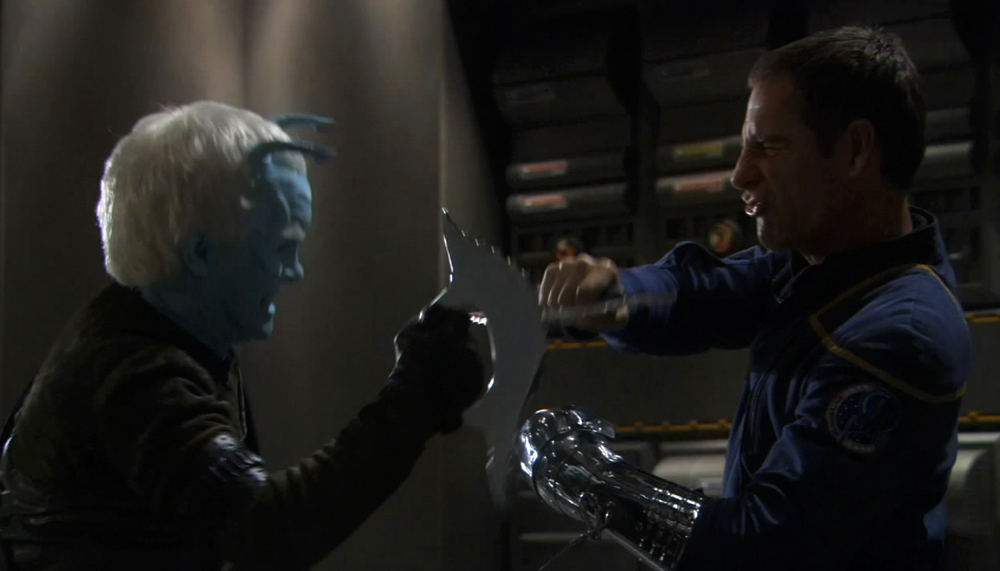
Kirk and Spock's stunt double battle to the death!
This one is easy. It's currently on Netflix in glorious HD. But don't start at the beginning, you won't like it. However, unlike modern shows, it got good very quickly. Start about halfway into the first season and then watch through the second season. If you need an even more abbreviated schedule, try the episodes "Balance of Terror," "The Galileo 7," "Space Seed" (prequel to Wrath of Khan), "Errand of Mercy," "The City on the Edge of Forever" (consistently voted the best Star Trek episode),  "Amok Time," "Mirror, Mirror," "The Doomsday Machine," "I, Mudd," "Journey to Babel," "The Trouble with Tribbles," "A Piece of the Action," and the only entry from season 3, "The Enterprise Incident." For you modern kids, the episodes all feature a 2006 40th Anniversary restoration which features new (but retro) digital effects.

2) Star Trek Films

You do not need to watch all of the films. I actually advise against it unless you are really devoted. But you do need to watch some of them in a certain order. Some of these films will be sporadically available on Netflix, but not all, which, unfortunately, means you'll have to find a friend that owns them.


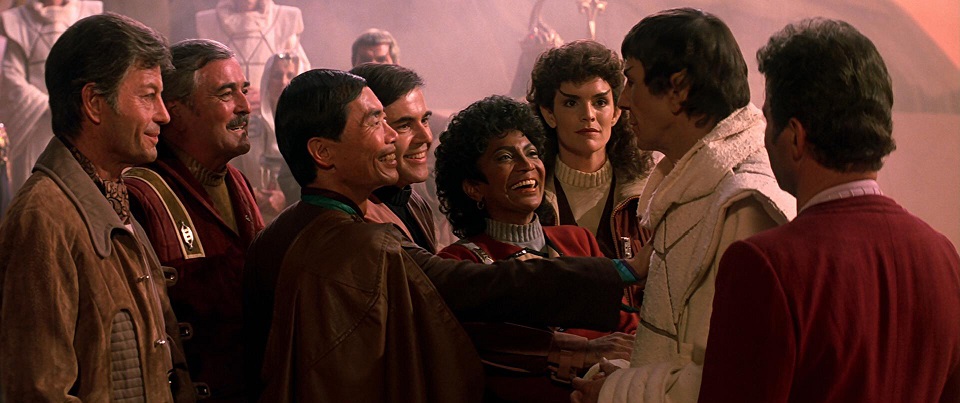
Star Trek II: The Wrath of Khan - the one that made Star Trek real

Star Trek III: The Search for Spock - the one that made Star Trek feel

Star Trek IV: The Voyage Home - the one that made Star Trek funny
Star Trek VI: The Undiscovered Country - the one that ended the Cold War

Star Trek: First Contact - it has the Borg.

You'll notice I only listed four of the original six films. As I indicated prior, there have been many creative influences on Star Trek. These films represent one creative direction that tells a unified story, and it is this thread that maintained Star Trek in the 1980's, paving the way for the series' that followed. This is "the good stuff," and its very good. It is these films that establish the Star Trek cast as real characters. The original show presented great archetypes but ultimately didn't allow for character growth due to the format of 1960's TV. These films change that, as they grow old and truly become friends. The JJ Abrams films synthesize the characters of these films with the hijinks of the series.

3) Star Trek: Enterprise

In a way, this is a proto-version of what JJ Abrams eventually succeeded at, which is to attempt to recapture the energy and spirit of the original series with new actors. A straight reboot was considered unthinkable, but a prequel series was deemed practical. An excellent series lead in Scott Bakula really sets this series apart. Since the original, no Star Trek captain was really able to headline the show (Patrick Stewart, while excellent, was still more the head of an ensemble). Bakula's Archer was a kinder, more respectable Kirk, less womanizer and more everyman. Starting out adventurous and curious, he develops more of an edge as the series progresses, eventually almost being spiritually isolated on the show. He is supported by an excellent cast, and one of the great unsung heroes of Star Trek, writer (and fourth season Showrunner) Manny Coto. He and Gene Coon (from the original series) are probably the two best writers to have shaped Star Trek. The connections between this series and the Abrams films are clear, as the new films serve as a better sequel to Enterprise than the original series really could. This series is also available on Netflix in HD, and you should watch the third season (a season long story arc) and much of the fourth. As a fairly recent show (canceled in 2005), it's very palatable to a modern audience. A small "resurrect Enteprise on Netflix" movement has quietly begun on Facebook in the wake of leaked information indicating its Netflix viewing figures are very good.

4) Star Trek and Star Trek Into Darkness

JJ Abrams' films that are more films based on Star Trek than Star Trek films. Very entertaining, capturing much of the fun and essence of the original. Good entertainment, buy a ticket. I can't review STID yet because its impossible to do without spoilers. But it's worth it. Interestingly, Leonard Nimoy, who was practically exiled by the Star Trek powers that be from 1994-2005 after directing 2 of the films and executive producing one (all three of which are on my list), really supports these films because he feels they honor the work he and his colleagues did in the 60's.

5) Other Stuff

Geek Trek...
Now I left a ton of stuff off this list! I'll explain why. I hate Voyager. I've tried Deep Space 9, and while I'll admit the concept sounds cool, I have never been able to enjoy it. Watching "The Trouble with Tribbles" back to back with its DS9 homage tells you everything you need to know: it's just not fun or funny. What Deep Space 9 and Voyager are is geeky. That's not a bad thing, but it does make them niche. If you like minutiae and techno-babble you will enjoy these series. Best wishes to you.

Finally: Star Trek The Next Generation

90's Airline Crew
To many people my age and older, this "is" Star Trek. The Shakespearean, android infested, techno-centric vision of Star Trek. Gene Roddenberry's late in life attempt to retake Star Trek (after Paramount removed him following the creative failure of the first film). In tone, Next Gen follows closely that first film, largely devoid of fun and hijinks, but heavy on philosophy. The original combined philosophy with fun. The films tended to embrace the fun, while Next Gen zeroed in on the philosophy. This was largely due to technical constraints (the series was produced on video and has only recently begun to be restored from its original negatives, and intensive and expensive process). The series produced many legendary Star Trek episodes such as "The Best of Both Worlds" and an excellent finale "All Good Things," but I cannot recommend it as essential Star Trek viewing. It's dense, long, and cultish; though it was intensely popular when it aired. Check it out, if it appeals to you, great. But if you are a newcomer, attracted by the characters and relationship types of the original, Next Gen will not appeal to you the same way. That said, of all the Star Trek spin-off's, it is the most original.

Click here for more movie reviews.

Thursday, May 16, 2013

Ayn Rand: Romantic?

Some time ago I came across this critique of Atlas Shrugged, which I just rediscovered while going through my partially-written posts. While the whole thing is good, the following excerpt is particularly striking:
Since I brought up human nature, there is also the matter of the thinness of Rand's anthropology. Rand's basic assertion is the rationality of human beings. (To the extent that a person is irrational, he is regarded as evil, anti-mind and anti-life.) And it is this conception of the human being as a rational, thinking being which leads to her ideal of the productive genius, his happiness, and the political order that would protect and preserve it. For Rand, the state only exists to shield the rational from the irrational, the good and the strong from ravenous desires of the wicked and the weak.

Of course, other rationalists have drawn strikingly different conclusions. In this regard, it useful to note that much serious political philosophy proceeds from a completely different premise -- the imperfect rationality of human beings -- and rightly so. If one considers Hobbes, say, or Spinoza, or Locke, three of the thinkers who inaugurated modern liberalism, one will notice that the fundamental problem of social life is that human beings are driven by their passions and their imaginations, by their hopes and their fears. It is these passions that create the problems and tensions that point to the need for stable political organization. While it is reason that leads them to enter into civil society -- to escape from the inconveniences of the state of nature -- the political order arranged is one that must take human beings as they are and not as the best they could be. This could be an authoritarian state, as it was for Hobbes, or a liberal democracy, as it was for Spinoza. In both cases, however, there is the recognition that human beings are passionate creatures, that the state is needed because of the problems inherent in human nature, that these problems may be alleviated somewhat in civil society but they won't go away.

Ironically, when one mulls it over, one may find that it's Galt and his band of strikers and dropouts who prove to be driven by their passions. Galt especially, who, despite his ultra-handsome looks and heroic self-understanding, can't muster up the gumption to just go up to the woman he has a massive crush on and ask her out for a drink -- or at least just talk to her -- and instead sits around chatting up her poor, love-struck assistant, hoping to catch a glimpse into her life.

Is this rational action, heroic action?

No, I think not. And aside from being somewhat creepy, it underscores the true impotence of Rand's hero. And it's not only with Dagny. When faced with the "communist" takeover of the motor factory, Galt doesn't seek out the banker Midas Mulligan and ask for a loan so that he can develop his motor on his own or attempt a run for political office; he just takes his toys and goes into hiding, hoping by such action to help hasten the apocalypse. This seems to me to be more like the behavior of a petulant adolescent than of the "highest man." Galt longs for a total transformation of human society, a complete victory for his higher morality and the unconditional surrender of those who oppose him, and he is content, indeed happy, to watch everything be destroyed to get there.

And the attempt to flee from reality courses through Rand's novel, from the disappeared and the destructive activities of Francisco D'Anconia and Ragnar Danneskjöld to Dangy's fruitless affair with Hank to the libertarian fantasyland of Galt's Gulch. Despite all of their speeches and protestations, these people are not so much stern rationalists but romantics. Such characters make terrible role models for those of us who are forced to reside in the world, which just may not be the stage for the struggle between the looting mystics and heroic individuals, but a place infinitely more complex, and more interesting. (Also, we should keep in mind that it is people convinced of their superior rationality and gnostic insights into the direction of world-historical change that generally pose the greatest challenge to the stability of the political order.)
Thoughts?

Monday, February 11, 2013

What Authority Do You Have Over Me?


Back when I was fifteen, I used to referee for a homeschool flag football league. My job was to make the calls and keep track of the points. Most of the time, it was easy. But one play stuck with me. The action was right on the sideline opposite me. I saw the kid step out-of-bounds as he dashed all the way down the field. Thinking he had scored, the boy danced triumphantly around the infield. I, however, made the call—he had gone out-of-bounds. I started to set the ball. The kids immediately began arguing with my decision. But I was in charge, and I had made my call. Just then, a “helpful” mom came over and offered me her video camera. Apparently, she had recorded the alleged touchdown.

She started to play it back and within a few seconds the dancing kid was cheering. The video evidence confirmed: he had stayed in bounds. I was less than thrilled. I had made my call. I was the authority on that field. I wanted to hold my ground. It was my RIGHT to say no. The problem was that it would have been wrong for me to do so.

A pastor once told me that fixing everything isn’t my job. He explained that there are certain institutions in life that have authority over people. The Bible talks about authority in relation to governments, families, churches, businesses, and friendships. Each of these have unique applications for what kind of authority they have and how it can be used.

The government has the authority to punish evil and reward good. Along with that comes the command authority to make laws and enforce them on society. Under certain extreme circumstances, a higher authority may require that we disobey a tyrannical government, but, in general, we are under the government and we must obey its agents; they have “command authority” over us.

Authority in the family is a bit different. The Bible calls on children to obey their parents much as it calls on everyone to obey government. But, as children grow up, the biblical requirement changes from obeying their parents to honoring them. Parents move from a role of “command authority” to a position more like that of an adviser. We respect them and give special weight to what they say because they have wisdom for us and because they have known us longer than anyone else. But, in the end, we are responsible for our own actions. (Within familial authority, there is also husband-wife authority, but I will not even try  to go into that here. This post is already way too long and even starting on that subject would turn it into a tome.)

Church authority is interesting because an individual pastor doesn't seem to have much authority at all. It is almost the opposite from the governing authority. Generally a church doesn't have command authority, but there are exceptions. Church authority comes into play when faced with a need to confront ongoing sin and (sometimes) to excommunicate people from the church. The rest of the time, however, the authority of a church is more like the authority of an adult’s parent; it’s primarily a source of wise council.

Business authority is unique in that it’s based primarily on contracts. This means that business authority can go from involving extreme amounts of command authority to involving almost none.  Regardless, we are commanded to work hard for our bosses and that includes submitting to them for as long as they are over us. In a sense, they own our labor, and we must honor that.

The last area where I see a Biblical grant of authority is an area that almost never comes up in this context. It’s the authority that friends have in our lives. This kind of authority is special because, unlike the rest, this authority only goes as far as it is given. For example: You can talk with me about girl problems because I let you. I didn't have to let you, but I do. This allows you to get serious and ask probing questions that we are both okay with. Accountability based relationships operate on the same principle. You give someone authority over part of you.  It is all based on trust and relationship. If one of these isn't strong, then there isn't real authority there.

Matthew 18 explains that we can confront a fellow believer if they have sinned against us, but this isn't permission to try to fix every Christian we run into. It also isn't permission to call out every problem. In fact, I don’t think it’s possible for us to try to fix everyone we meet without usurping either the authority of friendship or the authority of the church.

There are many problems that God has placed within each of our individual spheres of authority; it may be our duty to engage these issues. But there are also many problems in areas outside of our spheres, and we must resist the urge to act outside of our authority in our zeal to right wrongs. Sometimes we need to step back and analyze things so we can to figure out whether we have proper authority to try to fix a problem.

When I first figured out this concept, it was incredibly freeing. I realized that the problems God has placed within my authority are more than enough to keep me busy—I don't need to try to right every wrong.

But turn it around for a second: not only can you not fix every problem, but not everyone can fix your problems.

For instance, imagine a policeman. He may very well be a wonderful guy. But you should not go to him for help with leaving a drug habit. He might be forced to arrest you and you won’t get the mentoring that you need to deal with the spiritual problems that underpin the issue. That police officer is doing what God has called him to, but some ministry opportunities are now closed him.

I hope some of this is somewhat helpful. I like to paraphrase Lewis who said that he wrote to help people understand. If it helps, great! If not, discard it. I will not be offended.

Post by Jeremiah Lorrig 
Related Posts Plugin for WordPress, Blogger...