Showing posts with label art. Show all posts

Monday, February 16, 2015

Best George Washington Quotes

George Washington by Gilbert Stuart
Today is Presidents Day and therefore George Washington's birthday. In honor of the day, I have compiled my favorite quotes attributed to America's first president. I hope you can appreciate the wisdom here and are inspired by this great man.

----------------------------------------------------------------

“I hope I shall possess firmness and virtue enough to maintain what I consider the most enviable of all titles, the character of an honest man.” ― George Washington

Be courteous to all, but intimate with few, and let those few be well tried before you give them your confidence. - George Washington


True friendship is a plant of slow growth, and must undergo and withstand the shocks of adversity, before it is entitled to the appellation. - George Washington


Let your heart feel for the afflictions and distress of everyone, and let your hand give in proportion to your purse. - George Washington


I walk on untrodden ground. There is scarcely any part of my conduct which may not hereafter be drawn into precedent. - George Washington


Washington Crossing the Delaware by Emanuel Leutze
“To encourage literature and the arts is a duty which every good citizen owes to his country.” ― George Washington


“Real men despise battle, but will never run from it.” ― George Washington


“Be not glad at the misfortune of another, though he may be your enemy.” ― George Washington


George Washington by Robert Field
“The hour is fast approaching, on which the Honor and Success of this army, and the safety of our bleeding Country depend. Remember officers and Soldiers, that you are free men, fighting for the blessings of Liberty -- that slavery will be your portion, and that of your posterity, if you do not acquit yourselves like men.” ― George Washington


“I had rather be on my farm than be emperor of the world.” ― George Washington


“LIBERTY, when it begins to take root, is a plant of rapid growth.” ― George Washington


Truth will ultimately prevail where there is pains to bring it to light. - George Washington


It may be laid down as a primary position, and the basis of our system, that every Citizen who enjoys the protection of a Free Government, owes not only a proportion of his property, but even of his personal services to the defense of it. - George Washington

While we are contending for our own liberty, we should be very cautious not to violate the rights of conscience in others, ever considering that God alone is the judge of the hearts of men, and to him only in this case they are answerable. - George Washington

Signing of the Constitution by Howard Chandler Christy
Post by Jeremiah Lorrig

Wednesday, April 2, 2014

Darren Aronofsky's NOAH: A Conversation

It has been a long time since I have written a film review for this website. I only write reviews when films touch me in a particular way or motivate me to want to share about them, and 2013 was a bad year for me at the movies. But this weekend I saw a film that moved me to tears. And then the internet exploded. Evangelical Christians waged war against each other and against a host of ideas that are alleged to be represented by the film "Noah." As I walked out of church on Sunday, thinking about how the Facebook wars were only intensifying, I came to the understanding that simply writing a review and expressing myself in writing would only fuel the uglier parts of that fire, and not be conducive to productive dialog. I believe that the best dialog occurs face to face as people sit together and discuss as friends around the table. So rather than write a review, I asked two friends, a filmmaker and a pastor, to join me in discussing the film. The immediately agreed. One of them, the pastor, hadn't even seen the movie, but as soon as I asked him, he immediately went out and watched it so he would be prepared to discuss it. I am thankful to both of them for their willingness to serve others and make themselves available for me.

And so, I present Looking for Overland's first video blog! The first section is fairly spoiler free and good to watch whether or not you've seen the film. The remainder of the video tackles the specific issues that are in the film and while it will "spoil" the movie, if you are the kind of person that has read the reviews and articles before seeing the film, you should watch it. It's a worthwhile discussion, even if you ultimately decide to never watch Noah for yourself.


For the first thirty minutes, our panel, filmmaker Brandon Rice, seminary graduate and pastoral staff member Jake Putich, and filmmaker Daniel Noa, discuss their thoughts and takeaways from the film; the second thirty minute section addresses some of the criticisms being leveled against the film from the Christian community, while the last twenty minutes explores the nature of the reaction against Noah and why Christians are so divided over the release of this film. You can also listen to the conversation via SoundCloud.


Click here for more movie reviews.

Thursday, August 1, 2013

A Great Day: an Iliad House Day!

So I have a confession to make: I haven't been good with keeping up on blogging because I've been
Professor Portalis
inside Iliad House
working on something else. Something really fun.

If you read my review of "The Labyrinth" a year ago, you know I have always been an enthusiastic fan of Adventures in Odyssey. What I did not reveal explicitly in that review was the path that took my professional life into the orbit of men whom I consider to be giants in the Christian entertainment community: the creators and producers of Adventures in Odyssey.

The first episode of AIO I ever heard was "The Imagination Station." A high water mark which saw legendary character Digger Digwillow (Digger Digger Digwillow) go back in time to see Jesus's death and resurrection. Except he didn't actually go back in time. As a child I never understood that. When, in "Lincoln," Jimmy Barclay was unable to prevent the assassination, I assumed it was because he could not change history (or else I would not even be aware of the situation he was referring too). It was not until I was older that I understood what a safe construct the Imagination Station really was (in fact, in "The Mortal Coil" I assumed Whit's adventure about death was actually a time travel journey into your own future, a concept that terrifies me to this day, similar to HG Wells' apocalyptic vision of the end of the world; of nothingness).

But I never expected to meet the writers and creators behind this show. In 2010, I had heard maybe one Odyssey album in ten years when I went to visit some friends in Colorado Springs who are the kind of friends who feel it is their duty to make sure you have a fantastic time when you visit them. They had arranged through another friend to get me an informal tour of Focus on the Family headquarters (formal tours were not available then, though I understand they have since made a comeback). On that tour, we wandered into an office where I met a man named Jonathan Crowe, who's name I had heard and we had a nice conversation about the show and my filmmaking background. This was when I confirmed my suspicion that Odyssey recorded in Los Angeles and I made some breakfast recommendations that I believe the crew still relies on today. In response, Jonathan invited me to attend a recording session some months from then and I gratefully accepted.

Fast forward several months and Jonathan had suffered a terrible biking accident and couldn't attend the session (he's since fully recovered). But he graciously kept the invitation open and put me in touch with another great member of the Odyssey team, Nathan Hoobler. Nathan served as my tour guide into the production side of AIO, and that day I heard so many voices from my youth (and sadly missed many others). It was a good day, and I ended up helping them shoot a video for the Blackgaard Chronicles set; but ultimately the most eventful meeting I had that day was quite unexpected.

About halfway through the day a man came into the studio that I did not recognize. I knew all the people currently working on the show, and all were, for the most part, present. Then I heard him speak, and I realized who it was: Phil Lollar. But this was quite improbable. Phil had left the show in 2000, and hadn't been involved since. How could this be Phil Lollar? Turns out he was there to act, not produce, and played a small but humorous role in Album 53 (this foreshadowed his expanded role in "The Labyrinth in 55). Ironically, this meant he and I were the oddest men out in the room, and both sort of sat in the back for most of the day. I then later got to have dinner with the entire production team and observe a glorious reunion conversation between Paul McCusker and Phil Lollar (I also bought Paul McCusker a coffee, something I will always be able to say).

It was a fantastic experience, and eventually filed away into my memory. Then one day my old friend Jeremiah called me for a recommendation. He was helping produce the teen program at the Home School Legal Defense Association's National Leaders Conference in Orlando and they were going to do it on radio drama. He said they wanted to get someone from Adventures in Odyssey to be the keynote speaker for the program in Orlando, and since he knew about my experience, he wanted my advice on whom to ask. We discussed the merits of several of the people involved at length, all of whom would have made excellent guests, but it came down to me saying if he wanted someone who is just really funny, engaging, and is going to show the kids a good time, he should ask Phil. He did, and Phil said yes. And that is the conference that is mentioned on the Kickstarter page. That is how the founding members of Guess What met, and where Iliad House, at least for us, began.

It would be some time before I learned of Iliad House, of Professor Portalis, Jesse, and the magnificent Time Train (of doom?). Homer's Odyssey was about a journey, and his Iliad, a battle. But no matter what happens, my life has already been changed. I hope you'll come with us on this journey, and help us make Iliad House by donating to Kickstarter and then telling all your friends.

Here's an exclusive clip about the show only available here on Looking for Overland! Live long and prosper.

Wednesday, July 3, 2013

True Christian Films

In response to this article on Rick Santorum's new position as CEO of a production company (and with all respect to Senator Santorum), I had the following response on Facebook:


This article uncovers exactly what is wrong with Christian films right here when it says "One of the reasons might be the fact that christian movies are not global. They don’t translate well into other cultures."

This boggles my mind. If there is one religion that should translate to every culture (and mostly has, at one time or another) it's Christianity. So why don't Christian films?
Here's why: they are not "Christian". They are odes to a moralistic, American-dream centric, "wholesome" "family-friendly" lifestyle that has had the result of alienating in this country every person that does not conform to that image. This lifestyle is not a religion, but instead uses Christianity as a tool to attain its goal of cultural personal peace and affluence. 
True Christianity speaks to the heart. It speaks to the broken and the failed; the shameful. It is not "family friendly," for the very things you wish hidden from your children are the very things Christ came to save us from. How can you tell his story without them?

Allowing this Leave it to Beaver style "Christianity" to be the one that represents us to the culture is another in a long line of mistakes from the American church, a group which is quickly sliding into irrelevancy. These "leaders" are admitting their goal is not to change the culture but to insulate those they believe to be on the "inside" from those outside. It is inward, not outward focused. This is not "Christian," nor is it worthy of the name.

History Channel's "The Bible" Reviewed

Anyone who knows me knows that I love a good story. I particularly savor the beauty of such a story when shown on the big screen and told by a skilled cameraman. I relish witty dialogue penned by a sharp script writer, and I find myself immersed in a story portrayed by excellent actors. My heart swells with excitement when a well-written soundtrack pulls me into every emotion.

In short, a good story told with film can move my soul like little else can.

When I started watching The Bible series I expected to enjoy the story of the Bible played out on the screen.  I expected it to be well done and worth a bit of time.

What I didn't expect was the way it would impact me on the inside. Most Americans are familiar with many of the stories of both the New and Old Testaments. I, myself, have read these stories countless times. And they inspire me.

But, like the best literature, these stories are so deep that you can go through them 100 times and still realize something new on the 101st time.
The beauty of The Bible series is that it told the stories using a visual medium. It was like when I stood in St. Peter’s Basilica a Cathedral in Rome, my eyes transfixed on Michelangelo’s statue of Mary holding Jesus' body. The Scripture describes so much with words, but that statue captures something that cannot be expressed in words.

Words cannot express the way I feel after watching a visual portrayal of the calling of Matthew the disciple and the transformation of Saul of Tarshish into the Apostle Paul. The stoning of Stephen, the transformation of Nicodemus the Pharisee, the friendship of David and Jonathan, the awesomeness of the angles in Sodom, and the power of Peter's testimony were brought to life on the screen and brought the overarching story of God's story of redemption and love to life.

I could nitpick about how I didn't like the choice to use a narrator, the smallness of the crowds during the Exodus, or the wildness of the Prophet Jeremiah. But those issues were miniscule compared to everything else. I cannot claim that this series will change your life, but I can tell you that it changed mine.


The series isn't a substitute for the Scriptures, but it rings true to the central narrative: the transforming nature of what Christ does in our lives when we follow him.

If you are interested in reading more, Daniel Noa wrote a more detailed and traditional review for Looking for Overland and you can read it here! 

Posted by Jeremiah Lorrig

Click here for more movie reviews.


Thursday, March 28, 2013

"The Bible"

Updated: this series is now available to stream in HD on Netflix. Jeremiah also reviewed the series.

Original Post:

Those of you who read my posts know I get very passionate about films. I love films and I love the medium of visual storytelling. A good story is hard to come by, so when I see one I latch onto it and don't let go. My latest obsession is not a blockbuster, but a modest $22 million project; the ten-hour television miniseries entitled "The Bible."

David, with his friend Uriah,
invades Jerusalem.
This title is both deceptive and shockingly descriptive. For you see "The Bible" is not the scriptural summary it might lead you to think it is, but a lean, focused story about Jesus Christ. Don't let the fact that it spends 5 hours on a selection of Old-Testament characters fool you. Their stories are incredibly abbreviated, and though there are still two hours yet remaining, they have already spent four times the amount of screen-time on Jesus then they have on anyone else. This reveals a hidden bias on the part of the filmmakers: the the message of the Bible is primarily about the redemptive mission of Christ, and that the earlier stories primarily exist as the context and introductory chapels of the main narrative. That we should see the sacrifice of Christ in the context of the proposed sacrifice of Isaac, the deliverance he brings in light of Moses and Joshua, his kingship in light of David, and his faithfulness and power in light of Daniel.

Moses, as deliverer, is a Proto-Christ.
If you've read the Bible, you know the story. What's impressive is how closely the series adheres to it. It is surprisingly Protestant in its depiction. Now yes, I'm sure you've heard about the myriad departures and omissions made by the creative staff. But if looked at from the perspective of the many adaptations we've seen over the last ten years, its extremely faithful. More faithful than "The Hobbit" or "The Fellowship of the Ring." If you are looking for an exact visual record of the text of Scripture you will be disappointed. But there is no better way to experience the story of God's redemptive plan this Easter season than watching "The Bible."

The series is beautifully shot in Morocco, and since they shoot all the installments in the same general area, you see great continuity between the time periods. The actors are all unknown in the United States (though if you are like me, you might spot an Indiana Jones villain in there somewhere), and they use a wide ethnic diversity to represent a variety of characters. This is a reaction to the reality that most Bible characters were not British, or likely even white. Jesus is played by a Portuguese actor, angels by a variety of ethnicities, and yes, Samson by an African. If this offends you, I challenge to examine your pre-conceptions of the Bible. Many of the extras are clearly of North African descent (leading to some humorous comparison between one of the characters and President Obama), but again, this is due to the location of the filming of the series.
Only Jesus can throw the stone.

So now you're sad you've missed the show. Even though the first episode was the cable event of the year with 13 million viewers, and subsequent installments have hit 10 million, you weren't among them. Only one more episode left to air (and on Easter night) on the History Channel. Well I have some suggestions for you.

1: History will probably re-air them. If you have cable you can watch for free.
2: iTunes currently sells a season pass at a very reasonable price. Downside: cut up into hour installments instead of the 2 hours they were aired in. Also poor sound mix.
3: The series gets released on Blu-Ray and DVD on April 2nd, two days after Easter. This is the best way to experience the series, and a wonderful way to host showing for your friends and neighbors.
4: UPDATED in 2014 - the series is now on NETFLIX, in HD, with surround sound, and a spanish language track as well. For those of you with Netflix accounts, this just became a no brainer.


I am a huge fan of this series. Even the soundtrack is top notch with work by Hans Zimmer. I cannot recommend it to you enough. So from me to you, Happy Easter.

Click here for more movie reviews.

Friday, December 21, 2012

The Relevance of The Hobbit Today - Review (Part III)

I saw the film the day of the tragedy in Connecticut. With that on my mind, there was one line in particular that spoke to me out of the film. It does not represent, I think, current conventional thinking in America, certainly not among the ruling elite. Gandalf says to Galadriel, "Saruman believes it is only great power that can hold evil in check, but that is not what I have found. I found it is the small everyday deeds of ordinary folk that keep the darkness at bay. Small acts of kindness and love." In my heart, my thoughts turned to the Adam Lanza's of the world. No power of man can prevent what the insane (either physically or morally) of this world will decide to do. But perhaps small acts of kindness and love, when they start to add up, can disarm even the angriest rage or the most terrible hate. Jesus said to love your neighbor as yourself. He said blessed are the meek. In a world where people actually followed these teachings, would even the mentally ill feel so alone and unloved that they would need to tear down the fabric of society to attempt to ease their pain? I don't think we can ever truly know the answer, as evil will always be at the door, attempting to inflict more pain where there is none. But the thought, at least as I sat there watching the film, gave me hope.

Another, perhaps more controversial, aspect of this story, has to do with the dwarves as (rather obvious, I thought) stand-ins for the Jewish people, exiled from their homeland for generations. When Tolkien wrote The Hobbit, there was no State of Israel. The homeland of the Jews had long been ruled by other nations, and Tolkien, with his Western European education, would have most likely often thought back to the Crusades when thinking of the sort of ancient warlike situations he dealt with. The modern, shall we say, egalitarian view of the Crusades did not yet exist in England in the 1930s. It is quite possible that Tolkien thought of "Sarrasins" in "Orcish" terms. The film gives this even more weight, with talk of "others" going back to seize their homeland if they do not hurry. In Tolkien's day, after the First World War, the Middle East was being continually divided up by the western powers, with little thought being given either to the Jews or to the local inhabitants until 1945, long after The Hobbit's publication. So this story, in an odd way, is perhaps Tolkien's own little fantasy of how a very British person (for Bilbo is very mid-century British) could have potentially helped a group of nomadic Jews setting out to reclaim their ancient homeland. It's the very sort of mythic, Homer-esque (no, not Simpson) epic that Tolkien himself was drawn to, and writers often attempt to aspire to what they love.

Bilbo's eventual realization that he should help these dwarves simply because he can; because he possesses something they do not, is precisely the sort of "love thy neighbor" idea that no one really practices anymore, and thus is not considered "realistic." Our movie heroes must have some pragmatic goal in mind; Batman must be a "symbol" to inspire, because simply saving a couple people on his own really won't change much in the overall scheme of things. Superman must be darker and edgier, because a man who simply flies around saving cats and stopping bank robbers really isn't that interesting anymore. So, in this sense, Bilbo is now the ultimate "anti"-hero. I, for one, think we need more such "anti"-heroes, who are capable of committing acts of kindness, and love, for no good reason at all.


Jump back to Part I, or Part II - An Unexpected Pleasure.

Click here for more movie reviews.

Thursday, December 20, 2012

The Hobbit: An Unexpected Pleasure - Review (Part II)

"I did not give you that map and key so that you could cling to the past." I loved The Hobbit: The Unexpected Journey. I saw the film in 3D (conventional 3D, so there will be no discussion of the controversial 48 Frames Per Second issue here) and found it quite beautiful and immersive. Having seen it again since in 2D, I will say that I felt my eye actually had more to see in the 3D version, and so the film seems edited to favor the 3D experience, which makes sense, considering it was filmed in native 3D using 2 very high definition cameras.

Spoilers for The Hobbit: An Unexpected Journey follow:

The film is a very fun adventure story, and so very unique in our time. It is based on a third of a book, though I think it would be more accurate to say it is based on a third of a story. Tolkien wrote the entire history of Middle Earth in his books, and this film takes as its inspiration events during this time in that history, not limited solely to events written in The Hobbit itself. It may come as a surprise to many casual book fans that most of the "additional" material presented is not made up; no characters were introduced that do not appear elsewhere in Tolkien's writing, and character histories are, for the most part, respected. Scenes such as the battle outside Moria and the Necromancer are almost entirely lifted from other Tolkien writings, and I think they are well used here. As a child, I was very interested in the Necromancer and Dol Guldor, which Tolkien only briefly references in the book, and am very interested to see Benedict Cumberbatch (of Sherlock fame) play this pre-incarnate version of (spoiler!) Sauron. Since no comprehensive account of this battle between Gandalf and the weaker Sauron exists, this could be quite interesting, especially since, in The Lord of the Rings, Gandalf is clearly afraid of his enemy, and considers him now beyond his skill. (Part of me also hopes the Witch King of Angmar gets his own HBO show, as his history is further hinted at here, and there is enough payoff in The Return of the King to justify a little more of it in the next film). This aspect of the trilogy's plot, which I thought was well set up in this installment, has me the most intrigued, because it is the most original part of the films, and I am curious to see what happens.


I was also pleased at the inclusion of Radagast the Brown Wizard, and shocked and delighted by his depiction. He was actually featured in The Fellowship of the Ring, but removed from the film version. He really gets his moment to shine here though, and I hope we have not seen the last of him. I found the moments of absurdity in the film, such as his rabbit sled, very entertaining. I also enjoyed the depiction of his (and Gandalf's powers) in the film, which are more robust than in The Lord of the Rings. I look forward to the battles between the wizards and the Necromancer; I wonder if Radagast will face death (since he is not in Lord of the Rings, and even in the books, I thought he might be useful), and if Saruman will be guilty of any sort of early treachery. I'd also like to praise their efforts in executing Christoper Lee's return, as his health precluded any trips to New Zealand. They were able to film his dialog on a green-screen set in London, built to match the dimensions of their set in Wellington. I'm not sure if he and McKellen were ever in the same room, but their chemistry was trans-continental.

Speaking of which, this was Gandalf's movie. Ian McKellen gets top billing for the first time (does this make him eligible for Best Actor?) and he earns it. He glides through this film, firmly rooting it and just making it awesome. Gandalf really is, as Saruman calls him, a "meddler," and is orchestrating this whole situation to a purpose. The interplay between these great "guardians of Middle Earth," sent by divine powers is fascinating. I was also struck that of all the wizards, he is the one running around on catwalks with a sword, cutting great goblins to bits, and force pushing orcs into oblivion. It's a very active life for a wizard in any franchise.

I also appreciated the structure of the film itself. Many more critical of the film than I (including some in my family), found the film boring. The film does spend quite a bit of time in Bag End, toward the beginning. This is because the whole sequence is largely preserved as Tolkien wrote it. This sequence is his true introduction to Middle Earth, and if at some point anyone watches these films starting with The Hobbit, that scene will be crucial. It's the slow introduction to fantasy that often works well with first installments; the original Star Wars is structured similarly. It also lets us feel Bilbo's reluctance. If he is off on his adventure in the first ten minutes, we might be tempted to believe this is ordinary in Middle Earth. But the time it takes to convince him proves it is not. In this way, the film becomes a strong character piece for the titular hobbit. They then do begin their journey, pursued by Orcs. I do wonder if Gandalf's question, "who did you tell?", will get answered in future films. We are not given the answer, but I do wonder if the dwarves have a traitor in their midst? Azog the Goblin, played via motion capture by Manu Bennett, is a formidable opponent. I guess what I really liked about him was he is different from the other Orcs we have seen, more wild, and dangerous. CGI characters do not generally bother me in fantasy films, as I don't find a man with makeup and plastic on his face to be more convincing. Azog is sort of the General Grievous of the movie, and I liked Grievous just fine. Same goes for the Great Goblin himself, who reminded me of Jabba the Hutt, in the best way possible. The Lord of the Rings featured many villains, but none of them were particularly comical, and I enjoyed the change. I also really liked the goblin messenger, who reminded me of Jabba's court jester in Return of the Jedi, also in the best way possible. I enjoyed the structure of the film, featuring set up, light action, then rollicking Indiana Jones style action (Goblin town felt like a very 21st century Temple of Doom) leading into the finale. Much like they did with The Fellowship of the Ring, they were able to craft an ending to the first installment that felt both like an end to this part of the story and also teased what was to come. I am excited for the audiences to see what happens next as the worst is definitely not behind them.

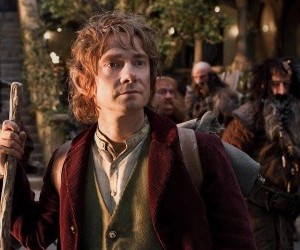
Of course, the MVP in all this is Martin Freeman as Bilbo. When he was first shown on screen I instantly thought that he was more like Bilbo than Ian Holm was. Peter Jackson is not George Lucas; as such he creates minor inconsistencies as he goes and ignores them. In Fellowship, Gandalf says Bilbo hasn't aged a day. He clearly has. Of course, in Fellowship, Gollum is black skinned with yellow eyes, so visual continuity is not paramount in this series, and I was ok with that, because I felt this film was true to itself; in particular, this Bilbo is true to himself.

Freeman plays every aspect of this character at once, creating a beautiful inner conflict that is a joy to watch. He is at once out of his element and yet embracing his new element as best as any normal person could. He takes to fighting in a way which we never saw Frodo, which makes him the coolest uncle you could ever have. He is also quintessentially British. Elijah Wood and Sean Astin were both Americans, feigning accents. Of the original four hobbits, only Dominic Monaghan was actually British. So, there is a certain restraint in Freeman's performance that I don't believe we saw in any of the hobbits in the previous three films. In that way, he brings real humanity to a role that could have easily been played as a very over-the-top caricature.  His groundedness allows us to enjoy the other, more fantastical aspects of the film.

I highly recommend this film if you enjoy fun, entertaining movies. If you hate fun, comedy, CGI, or good british actors, don't go see this movie. I for one love all of the above.

Update: I've since seen the film in 48 frames-per-second, and while I do now believe that 3D is the best way to view this film, I found the seemingly accelerated motion distracting and detracting from certain strong actor performance moments I noticed at the standard speed.

Click for part 3 of my review, "The Relevance of the Hobbit Today,"
Or, go back to Part I.

Click here for more movie reviews.

Wednesday, October 31, 2012

Freedom of Choice?

There are many in our country who ultimately believe that if you could obtain enough information and generate enough accurate algorithms based on sound social science, a centralized command society would not only be efficient but be the best for all. "From each according to his ability, to each according to his need," beautifully realized by science and technology. This is best realized when you hear someone say "communism is great it just doesn't work?" Is it great? Is it really great for the human experience to be homogenized? I recently heard a nutritionist say that talking about what people "should" eat is like deciding what monkeys should eat in a zoo. Should we live in a zoo?

The film I've just completed deals with these issues and many others that face us as we come into this election. The nature and proper role of government is still something that we are very divided on in this country. But where are we headed? A majority of Americans believe we are on the "wrong track." Where does this track take us?

Let's jump ahead and find out:

Thursday, October 18, 2012

Les Miserables and Dreaming the American Dream

Victor Hugo’s Les Miserables has long been considered a classic work. But recently, something happened that made the story a pop culture phenomenon. The musical adaptation especially has grown in popularity: Nick Jonas played a lead in the 25th anniversary production; Susan Boyle preformed a sensational rendition of “I Dreamed a Dream” for “Britain’s Got Talent; Russell Crowe, Anne Hathaway, and Hugh Jackman star in a high-budget LesMis film coming this fall. What hurdled the classic story into the 21st Century phenomenon?

The phase most often associated with the story is “I dreamed a dream...” The 25th anniversary production was advertised as “Dream the Dream,” Susan Boyle sang the powerful song “I Dreamed a Dream,” and the many people sat up and paid attention to the first Les Mis movie trailer because of the haunting music of that same song which overlaid the entire ad.


Why? People today have a deep connection with “I Dreamed a Dream” because they themselves are living the full cycle of the sad song. The song opens with optimism and hope—it reminds me of the 1990s. There was nothing that could not be done in the 90s. Hope was high and the sky was the limit. The possibilities were endless, and anyone could dream a dream. New companies were sprouting, creating new industries. Everyone knew that, if you wanted to start your own business, all you needed was an idea. If you went to college, you could find a job and succeed—even if you wanted to study something abstract. The words of “I Dreamed a Dream” embody the 90s:
I dreamed a dream in time gone by
When hope was high
And life worth living
I dreamed that love would never die
I dreamed that God would be forgiving

But then life killed the dreams. Terrorists ravished America’s optimism on a September morning. Then, we realized that some of those who had fed us hope were tigers with soft voices, taking advantage of the spirit of the age to build our hopes into companies like Enron and make off with the cash: charlatans preying on dreams.

But the tigers come at night
With their voices soft as thunder
As they tear your hope apart
As they turn your dream to shame

Then came the storm of the collapsing economy. In the last four years, things have gotten so bad that one out of two new college graduates are unemployed or underemployed, and among young adults one out of four now live with their parents. Many of these young people were told that they could live their dreams, that anything was possible. They were told that they could make the world a better place. But life has killed their dreams. Now, they’re lucky if they can find a job at a department store.

I had a dream my life would be
So different from this hell I'm living
So different now from what it seemed
Now life has killed the dream I dreamed.

Personally, I fear that if we kill the dreams of this generation we’ll end up with a society that stagnates because we can’t dare to “go to the moon in this decade.” We won't be able to declare that we’ll “one day live in a nation where they will not be judged by the color of their skin but by the content of their character.” If we kill the ability to dream, who will be able to say “I know not what course others may take, but as for me, give me liberty or give me death!”?

History shows that great men are great dreamers. Courage is born of the ability to dream. So, let’s fight to restore America’s capacity to dream! Let’s each agree to fight for the American Dream, each in our own way. Remember to dream. Stand with those who struggle to dream. Participate in our democracy by stepping out of your comfort zone and doing what you can to shape the course of America. Share your dreams by talking about why you believe what you do. Exercise your freedom.  Dream the dream! 

Post by Jeremiah Lorrig

Wednesday, July 18, 2012

Batman Begins: Birth of a Hero

Some people are snobs. They assume because a story is told in a movie theater is only entertainment and/or action. I completely disagree. Some of the greatest works of literature were penned for the stage. If Shakespeare’s plays can go down in history as great literature, I believe that there are some movies that deserve a place in the same category. One of those is Batman Begins.

This story grabs your attention with incredible action and cool gadgets, but more important than that, the dialogue, characters, and story not only delve into the soul but also unravel part of the Gordian Knot of human struggles.

Batman Begins, at its core, is a movie about Bruce Wayne. No other Batman movie has come half as close to being a story about the title character. Like It’s a Wonderful Life, we walk with the lead from his childhood to his young adult life and finally into the fullness of Batman.


As we walk with him we discover the same lessons that he learns. We learn that fear is something that we must all face. We learn that life is hard, but we have a choice as to what we are going to do with it. We also learn with Bruce that mercy is what defines good from bad.

As I watched the movie again last night I was reminded of why this movie is so powerful. When Bruce Wayne is struggling with understanding who is to blame for his parents murder, he struggles with guilt because he was the one who asks them to leave early exiting the building into a quiet alley. But Alfred reminds him that the killer is the only one to blame. Then later Henri Ducard (the movie’s dark Obi-Wan Kenobi) tries to coldly blame the deaths on Bruce’s father for failing to protect his wife. Finally, Bruce is forced to face someone who round claims 
about credit for their deaths by causing the economic downfall of the city. This was a deliberate action done in hope of creating people like the murderer to tear the city apart.

Because of its nuance, complexity, and realism (an uncommon description for a Super Hero movie), Batman Begins redefines the “character origins” film. Clearly the entire story is about the beginning of Batman, but what makes it amazing is the little things like the incredible supporting characters. 

Michael Caine is inspired as Alfred, the wise support that seems to hold the Bruce Wayne’s world together. The other characters Rachel Dawes, Lucius Fox, Jim Gordan, and even the homeless Russian play key roles in Bruce’s life making him better and inspiring him to fight for true justice. 

These supporting characters stand in sharp contrast with the bad guys who also each play a key role in making Batman who he is. First there is Falcone, a mob boss who “owns the town.” He shows Batman power that money cannot buy and that corruption obscures justice, sending Bruce into a tailspin leading him to a prison in Asia. Then we have Dr. Crane, who says “I respect the mind's power over the body. It's why I do what I do.” In a real way he is the linchpin of the plot against the city. He is no match for Batman’s strength but his mask and weaponized drugs disable Batman for two painful days. Dr. Crane is someone that isn’t beaten by power or strength. That is a new lesson one for Batman, that he must learn because strength is not enough to save the city. 


Now, let’s talk about Henri Ducard. He cannot be fully placed with the villains who stand in Bruce’s way or with the supporting characters who build him up to be the hero he needs to be. I mentioned it earlier that he is a dark Obi-Wan Kenobi character. He finds our hero and takes him in. Ducard trains Bruce giving him the skills he needs to fight evil. He reinforces Bruce’s desire to see justice and helps him to face his fears. But it is all because he wants to use the Prince of Gotham to take down the city.

Ducard is complex and clearly hides behind many layers of deception and is driven by a desire for revenge that he perversely conflates with justice. He is a mentor whose training is not lost on his prize student. In the end, however, when the choice comes Bruce chooses to reject his master's plan and returns home having learned a new lesson: justice must be carried out in the right way and through the right channel.

Batman Begins is the new standard for origin stories. It pulls you from the very roots of what makes the hero who he is into the relationships that shape him. Finally it launches you into a world where the person the hero has become is able to overcome and turn back evil.

Post by Jeremiah Lorrig

Check back tomorrow for Daniel’s retrospective review of The Dark Knight.
Check back Friday for our review of The Dark Knight Rises.


The Dark Knight Rises opens in theaters everywhere Friday, July 20th.


Click here for more movie reviews.

Monday, July 2, 2012

The Glory of Heroes!


I don’t know if I’m the only one, but whatever I read impacts me.  Maybe it’s because I have an overactive imagination. But when I read about mysteries, I begin to notice potential “clues” in the details of everyday life. When I read about great leaders from the past, I start seeing the seeds of greatness in those around me. And when I read about ancient Greeks (like I am right now, in the Iliad), I think about glory.

The Iliad should be subtitled “101 ways to kill someone with a spear,” but if you hack your way through the action scenes, you can become acquainted with some of the characters. As you get to know them you discover that they are driven by a very powerful force: they live and die for glory.

Our culture has largely lost the meaning of “glory.” Today the closest thing we really have is “fame” or “popularity.” But glory goes deeper than these things. Glory is not something that happens because you are well known; glory is something that you must earn. It is something that makes you worthy of honor. Glory is the thing that urges people to tell and listen to stories about the greatness and worthiness of your deeds. It is something that, quite frankly, most of us would shy away from because we feel that we do not deserve such high praise.

Christians know that God is worthy of glory. He is good enough for it. We, by comparison, are nothing. So many people reason that God alone should have glory.

The heroes of Greek mythology were proud. They saw glory as something worth attaining. They fought and died for it. Because of glory, they would get up and fight on even when they were bleeding out in a losing battle. These heroes would turn the tide of wars! They would conquer unspeakable beasts. And, at times, they would even take on the immortals. Many of these heroes were inspired to lofty deeds because they believed that they had the blood of the gods in them. They thought they could win great glory because they were the children of the gods. Something about this struck me as I was reading today.

As Christians, we are sustained by the blood of the one true God; we’ve been adopted into God’s own family. That’s more powerful than being the son of Zeus! Because we are children of God, we can gain glory for His name. We have the ability to overcome huge obstacles. We can defeat the enemy by the power of His name. We can battle not only against flesh and blood, but also against principalities and powers. (How cool is that?)

Unlike the Greeks, I have to remember that God is the source of every good thing I do and that the glory belongs to Him. The Greeks, however, foreshadowed the truth. I am a son of God. Because of that, I am expected to be a hero and win glory for His name! Like the Greek gods did for their children in the Iliad, my Heavenly Father gives me strength, protects me, and even fights for me on occasion. Only He does it a whole lot better than Zeus or Poseidon ever could.

We live in days of excitement and challenge. But we need to take of the metaphorical spear into hand and boldly face the challenges of our day. Who knows? Maybe 1,000 years from now someone will be inspired by you, because you were a champion from the days when heroes won glory for His name!

Post by Jeremiah Lorrig  

Sunday, June 24, 2012

Brave Movie Review

From Pixar's Facebook. 
Any movie with the line "We'll expect your declarations of war in the morning" is going to catch my attention. This is even more likely when it is said in a fetching Scottish accent. Ever since I saw the poster for Pixar’s Brave on the wall of the theater almost two years ago I have been waiting for this movie with great anticipation.

It is not often that we get to see a mother/daughter movie. Brave grasps the complexity of the relationship between a maturing girl and her mother and centers this awkward time around the conflict of the princess’s impending marriage.

The girl, Princess Merida, rejects her mother and becomes so caught up in herself that she ends up causing major trouble for her whole family, specifically her mother. Through a twist of fate, she ends up being the only one who stands with her mother when things get really tough out in the wild. Merida discovers that she was wrong and that her mother has always loved her deeply. The queen discovers that having some hunting skills can be very useful (although she still insists that princesses do not put their weapons on the table).

In the course of the story, Merida begins to follow the path of one of the characters from one of the legends her mother taught her. In fact, Brave cleverly takes two stories separated by generations (Merida’s life and a legend her mother describes) and contrasts them against each other to teach valuable lessons.

In both cases, someone feels like they are not being treated fairly. Both decide to take fate into their own hands. Both tear their families asunder.

Repentance, however, leads to redemption. In the end the film shows the consequences of breaking the 5th commandment as well as the Scripture that says “do not provoke your children to wrath.”

I encourage anyone to see the movie. It is the only mother/daughter movie that I have seen that really is not a “girl's movie” and can be enjoyed by anyone. When I saw the promotions for Brave I knew that it would be a must see. The acting is grand (the little girl reminds me of my little sister). The music is breathtaking. The animation is flawless. In the trailers, they wisely leave out major plot points so that you don’t know where the movie is going, so you really can get caught up in enjoying the movie.

And as has become custom in Pixar movies, they touched my heart, and I cried.


Review by Jeremiah Lorrig
Check out our other reviews here.


(Listen to the music! It is amazing.)

Click here for more movie reviews.
Related Posts Plugin for WordPress, Blogger...