Showing posts with label The Hobbit. Show all posts

Thursday, January 3, 2013

My Year in Ticket Stubs

So, as I was cleaning my room tonight this is what I found:

Tickets to: 


  • Gettysburg Battlefield (12/10/11)
  • the Nutcracker (12/11) 
  • The Hunger Games (3/25/12)
  • Midsummer Night's Dream play (3/30/12)
  • The Avengers (5/4/12) 
  • Avengers (5/10/12) 
  • Avengers (5/20/12) 
  • The Avengers (5/29/12)
  • Brave (6/23/12) 
  • Bourne Legacy (8/11/12)
  • Amazing Spiderman (8/21/12)
  • Colonial Williamsberg (9/12) 
  • Dark Knight Rises (9/12/12) 
  • Values Voter Summit Gala (9/15/12) 
  • Disney World (9/28/12) 
  • Ryan Rally VIP ticket 
  • Argo (10/27/12) 
  • Romney Rally VIP ticket  
  • Wreck-It-Ralph (11/9/12) 
  • Skyfall (11/18/12)
  • The Hobbit (12/15/12)
  • Les Miserables the play (12/15/12) 
  • The Hobbit 48 FPS (12/24/12) 
  • Les Miserables (12/26/12)
There is a reviewer who ranks movies as the year goes on. Do you all think I should do that too? This is what it would look like. 

I guess I can make a chronicle of my life based on my messy room. Did you see any of these things? What was your favorite? 

Posted by Jeremiah Lorrig

Click here for more movie reviews.

Friday, December 21, 2012

The Relevance of The Hobbit Today - Review (Part III)

I saw the film the day of the tragedy in Connecticut. With that on my mind, there was one line in particular that spoke to me out of the film. It does not represent, I think, current conventional thinking in America, certainly not among the ruling elite. Gandalf says to Galadriel, "Saruman believes it is only great power that can hold evil in check, but that is not what I have found. I found it is the small everyday deeds of ordinary folk that keep the darkness at bay. Small acts of kindness and love." In my heart, my thoughts turned to the Adam Lanza's of the world. No power of man can prevent what the insane (either physically or morally) of this world will decide to do. But perhaps small acts of kindness and love, when they start to add up, can disarm even the angriest rage or the most terrible hate. Jesus said to love your neighbor as yourself. He said blessed are the meek. In a world where people actually followed these teachings, would even the mentally ill feel so alone and unloved that they would need to tear down the fabric of society to attempt to ease their pain? I don't think we can ever truly know the answer, as evil will always be at the door, attempting to inflict more pain where there is none. But the thought, at least as I sat there watching the film, gave me hope.

Another, perhaps more controversial, aspect of this story, has to do with the dwarves as (rather obvious, I thought) stand-ins for the Jewish people, exiled from their homeland for generations. When Tolkien wrote The Hobbit, there was no State of Israel. The homeland of the Jews had long been ruled by other nations, and Tolkien, with his Western European education, would have most likely often thought back to the Crusades when thinking of the sort of ancient warlike situations he dealt with. The modern, shall we say, egalitarian view of the Crusades did not yet exist in England in the 1930s. It is quite possible that Tolkien thought of "Sarrasins" in "Orcish" terms. The film gives this even more weight, with talk of "others" going back to seize their homeland if they do not hurry. In Tolkien's day, after the First World War, the Middle East was being continually divided up by the western powers, with little thought being given either to the Jews or to the local inhabitants until 1945, long after The Hobbit's publication. So this story, in an odd way, is perhaps Tolkien's own little fantasy of how a very British person (for Bilbo is very mid-century British) could have potentially helped a group of nomadic Jews setting out to reclaim their ancient homeland. It's the very sort of mythic, Homer-esque (no, not Simpson) epic that Tolkien himself was drawn to, and writers often attempt to aspire to what they love.

Bilbo's eventual realization that he should help these dwarves simply because he can; because he possesses something they do not, is precisely the sort of "love thy neighbor" idea that no one really practices anymore, and thus is not considered "realistic." Our movie heroes must have some pragmatic goal in mind; Batman must be a "symbol" to inspire, because simply saving a couple people on his own really won't change much in the overall scheme of things. Superman must be darker and edgier, because a man who simply flies around saving cats and stopping bank robbers really isn't that interesting anymore. So, in this sense, Bilbo is now the ultimate "anti"-hero. I, for one, think we need more such "anti"-heroes, who are capable of committing acts of kindness, and love, for no good reason at all.


Jump back to Part I, or Part II - An Unexpected Pleasure.

Click here for more movie reviews.

Thursday, December 20, 2012

The Hobbit: An Unexpected Pleasure - Review (Part II)

"I did not give you that map and key so that you could cling to the past." I loved The Hobbit: The Unexpected Journey. I saw the film in 3D (conventional 3D, so there will be no discussion of the controversial 48 Frames Per Second issue here) and found it quite beautiful and immersive. Having seen it again since in 2D, I will say that I felt my eye actually had more to see in the 3D version, and so the film seems edited to favor the 3D experience, which makes sense, considering it was filmed in native 3D using 2 very high definition cameras.

Spoilers for The Hobbit: An Unexpected Journey follow:

The film is a very fun adventure story, and so very unique in our time. It is based on a third of a book, though I think it would be more accurate to say it is based on a third of a story. Tolkien wrote the entire history of Middle Earth in his books, and this film takes as its inspiration events during this time in that history, not limited solely to events written in The Hobbit itself. It may come as a surprise to many casual book fans that most of the "additional" material presented is not made up; no characters were introduced that do not appear elsewhere in Tolkien's writing, and character histories are, for the most part, respected. Scenes such as the battle outside Moria and the Necromancer are almost entirely lifted from other Tolkien writings, and I think they are well used here. As a child, I was very interested in the Necromancer and Dol Guldor, which Tolkien only briefly references in the book, and am very interested to see Benedict Cumberbatch (of Sherlock fame) play this pre-incarnate version of (spoiler!) Sauron. Since no comprehensive account of this battle between Gandalf and the weaker Sauron exists, this could be quite interesting, especially since, in The Lord of the Rings, Gandalf is clearly afraid of his enemy, and considers him now beyond his skill. (Part of me also hopes the Witch King of Angmar gets his own HBO show, as his history is further hinted at here, and there is enough payoff in The Return of the King to justify a little more of it in the next film). This aspect of the trilogy's plot, which I thought was well set up in this installment, has me the most intrigued, because it is the most original part of the films, and I am curious to see what happens.


I was also pleased at the inclusion of Radagast the Brown Wizard, and shocked and delighted by his depiction. He was actually featured in The Fellowship of the Ring, but removed from the film version. He really gets his moment to shine here though, and I hope we have not seen the last of him. I found the moments of absurdity in the film, such as his rabbit sled, very entertaining. I also enjoyed the depiction of his (and Gandalf's powers) in the film, which are more robust than in The Lord of the Rings. I look forward to the battles between the wizards and the Necromancer; I wonder if Radagast will face death (since he is not in Lord of the Rings, and even in the books, I thought he might be useful), and if Saruman will be guilty of any sort of early treachery. I'd also like to praise their efforts in executing Christoper Lee's return, as his health precluded any trips to New Zealand. They were able to film his dialog on a green-screen set in London, built to match the dimensions of their set in Wellington. I'm not sure if he and McKellen were ever in the same room, but their chemistry was trans-continental.

Speaking of which, this was Gandalf's movie. Ian McKellen gets top billing for the first time (does this make him eligible for Best Actor?) and he earns it. He glides through this film, firmly rooting it and just making it awesome. Gandalf really is, as Saruman calls him, a "meddler," and is orchestrating this whole situation to a purpose. The interplay between these great "guardians of Middle Earth," sent by divine powers is fascinating. I was also struck that of all the wizards, he is the one running around on catwalks with a sword, cutting great goblins to bits, and force pushing orcs into oblivion. It's a very active life for a wizard in any franchise.

I also appreciated the structure of the film itself. Many more critical of the film than I (including some in my family), found the film boring. The film does spend quite a bit of time in Bag End, toward the beginning. This is because the whole sequence is largely preserved as Tolkien wrote it. This sequence is his true introduction to Middle Earth, and if at some point anyone watches these films starting with The Hobbit, that scene will be crucial. It's the slow introduction to fantasy that often works well with first installments; the original Star Wars is structured similarly. It also lets us feel Bilbo's reluctance. If he is off on his adventure in the first ten minutes, we might be tempted to believe this is ordinary in Middle Earth. But the time it takes to convince him proves it is not. In this way, the film becomes a strong character piece for the titular hobbit. They then do begin their journey, pursued by Orcs. I do wonder if Gandalf's question, "who did you tell?", will get answered in future films. We are not given the answer, but I do wonder if the dwarves have a traitor in their midst? Azog the Goblin, played via motion capture by Manu Bennett, is a formidable opponent. I guess what I really liked about him was he is different from the other Orcs we have seen, more wild, and dangerous. CGI characters do not generally bother me in fantasy films, as I don't find a man with makeup and plastic on his face to be more convincing. Azog is sort of the General Grievous of the movie, and I liked Grievous just fine. Same goes for the Great Goblin himself, who reminded me of Jabba the Hutt, in the best way possible. The Lord of the Rings featured many villains, but none of them were particularly comical, and I enjoyed the change. I also really liked the goblin messenger, who reminded me of Jabba's court jester in Return of the Jedi, also in the best way possible. I enjoyed the structure of the film, featuring set up, light action, then rollicking Indiana Jones style action (Goblin town felt like a very 21st century Temple of Doom) leading into the finale. Much like they did with The Fellowship of the Ring, they were able to craft an ending to the first installment that felt both like an end to this part of the story and also teased what was to come. I am excited for the audiences to see what happens next as the worst is definitely not behind them.

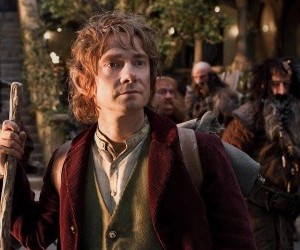
Of course, the MVP in all this is Martin Freeman as Bilbo. When he was first shown on screen I instantly thought that he was more like Bilbo than Ian Holm was. Peter Jackson is not George Lucas; as such he creates minor inconsistencies as he goes and ignores them. In Fellowship, Gandalf says Bilbo hasn't aged a day. He clearly has. Of course, in Fellowship, Gollum is black skinned with yellow eyes, so visual continuity is not paramount in this series, and I was ok with that, because I felt this film was true to itself; in particular, this Bilbo is true to himself.

Freeman plays every aspect of this character at once, creating a beautiful inner conflict that is a joy to watch. He is at once out of his element and yet embracing his new element as best as any normal person could. He takes to fighting in a way which we never saw Frodo, which makes him the coolest uncle you could ever have. He is also quintessentially British. Elijah Wood and Sean Astin were both Americans, feigning accents. Of the original four hobbits, only Dominic Monaghan was actually British. So, there is a certain restraint in Freeman's performance that I don't believe we saw in any of the hobbits in the previous three films. In that way, he brings real humanity to a role that could have easily been played as a very over-the-top caricature.  His groundedness allows us to enjoy the other, more fantastical aspects of the film.

I highly recommend this film if you enjoy fun, entertaining movies. If you hate fun, comedy, CGI, or good british actors, don't go see this movie. I for one love all of the above.

Update: I've since seen the film in 48 frames-per-second, and while I do now believe that 3D is the best way to view this film, I found the seemingly accelerated motion distracting and detracting from certain strong actor performance moments I noticed at the standard speed.

Click for part 3 of my review, "The Relevance of the Hobbit Today,"
Or, go back to Part I.

Click here for more movie reviews.

Wednesday, December 19, 2012

The Hobbit: An Unexpected Journey - Review (Part I)

There is a disturbing trend happening with major movie releases these days. According to critics (and many audience members), a new film is either an amazingly surprising hit, or it is a disappointment. This verdict can almost be completely pre-determined by the collective expectations preceding the film's release. With almost no films budgeted over $100 million based on original material, all major releases are either sequels (or prequels, which are still actually sequels) or based on other media such as books, tv shows, comic book characters, or, rarely, plays; which means that each has dedicated fans who have very ingrained pre-conceived notions about what their favorite thing is really all about.

Calypso and Assante from
"The Odyssey" (1997)
Before 2001, this was why most successful works of fiction were not made into films. The conventional wisdom was that film adaptations could not do major works of fiction justice. One only has to watch the Armand Assante version of The Odyssey or the BBC productions of The Chronicles of Narnia to see that this is true. Even most comic book films of the period were dismal both in their quality and in their ability to translate what millions loved into something that worked on the screen.

But The Lord of the Rings: The Fellowship of the Ring (2001) changed all of this. A hit with fans of the book and general audiences alike, this film opened the door to what has become a decade of, well, unoriginality at the movies. So, in 2012, the tentpole releases were The Avengers (sixth in a series), The Dark Knight Rises (third, or seventh, or eighth, depending on how you count), The Bourne Legacy (fourth), Skyfall (23rd), and now The Hobbit: An Unexpected Journey. With The Avengers, many doubted that anyone could make a film with so many super heroes in it work. They were pleasantly surprised that it did work and so one of the slimmest plotted films of the year went down as one of its best. Whereas the critics were expecting the second coming of Christ with The Dark Knight Rises, and instead greeted it with indifference, perhaps not liking so much what it had to say.


A similar phenomenon occurred with The Hobbit: An Unexpected Journey in that The Lord of the Rings Trilogy is one of the few films of the last decade everyone can admit to liking without drawing looks of disgust from one corner of the room. So, many in the media were looking forward to experiencing a new revelation in cinema. Suffice to say they did not. Nor should they have.

Tolkien's The Fellowship of the Ring is arguably his greatest single work. The amount of character development and pathos in that book is unmatched in his other writings. If you've read The Silmarillion, you know he actually writes in a very distant, objective style. This is actually one of the reasons The Hobbit is such a short book, page count wise. The stone giant sequence in the film that has been criticized by many is straight from the book, but it only occupies one sentence. It is not described. But in those days, people weren't as critical (or so it would seem), and this was not considered a problem. When translating such a story to film, where things are shown, and not told, one cannot avoid depicting such a fantastic sight. Tolkien's writing is full of such little asides and tangents that are irrelevant to the overall plot but essential to the atmosphere of his fairy tale world.

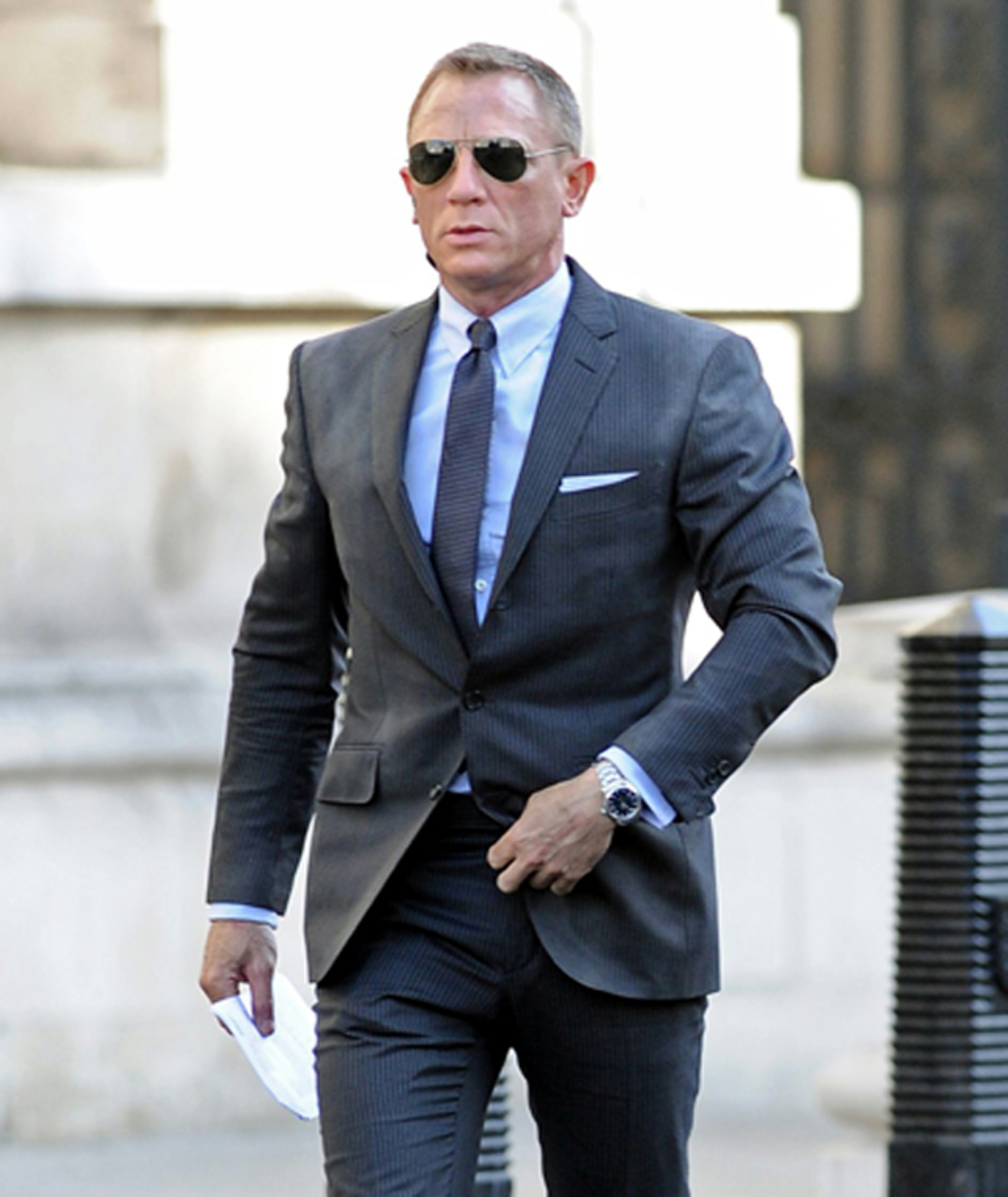
Daniel Craig in "Skyfall"
The Hobbit simply isn't as strong a book as The Fellowship of the Ring; however, it's a great book. It's a funny book, a moving book, a (melo)dramatic book, and a wonderful story. But it is different; and movie goers (and especially critics) don't like "different." They say they do; they will say "this film breaks new ground," or it "defies the stereotype," but it actually doesn't. Skyfall earned a lot of praise for being a "different" kind of Bond film; when in reality, it simply wasn't a Bond film. Had that same film been made under a different name or with a different character, it would not have merited their notice, because it is exactly like every other action film of the past five years. It is in essence not "different," but in line with the styles of the time; this dark, "ultra-real," "gritty," aesthetic that is currently in vogue, where no CGI is used and lots of people die horrifying deaths. In Skyfall, our "hero" saves no one, and does nothing remotely heroic. This was loved by the critics of our day. "The Hobbit: An Unexpected Journey" does not fall in line with this aesthetic, and therefore has not earned their favor.

Continue on to Part II - An Unexpected Pleasure.
Or skip to Part III - The Relevance of the Hobbit Today.


Click here for more movie reviews.
Related Posts Plugin for WordPress, Blogger...