Showing posts with label superheros. Show all posts

Thursday, April 24, 2014

Winter Soldier: Revenge of the Millennials

I know we already did a review of Captain America: The Winter Soldier, but I believe there is still another aspect that needs further exploration. Jeremiah noted in his review that this movie feels a little different than the prior ones. I felt the same way, but maybe not for the same reasons. (*Spoilers ahead*)

Captain America: The Winter Soldier is darker than the prior Marvel movies. Of course, there are the obvious political conclusions to be drawn: the danger of an all-powerful shadowy agency out to protect us, the irresponsible use of technology, the latent despotism of a surveillance state.

But I suggest there is a cultural critique, conscious or unconscious, going on that is even deeper. This movie is about the fall of the people and institutions we trusted. It's about being taken advantage of by the leaders we looked up to. It's about being used and lied to by the people we thought were friends. It's about the blurring together of the "good" institutions and the "bad" institutions. And, most importantly, it's about determining who our true friends are--that little pocket of community that we can truly trust.

This is the story of the millennials. The adrift generation, steeped in optimism yet feeling manipulated and used by the very people who they are supposed to save; held to the impossible standard of being expected to clean up an inherited mess without ruffling the feathers of those who made the mess in the first place; deemed by their elders to be entitled, narcisistic, and unable to grow up; and accused of being more wiling to shoot at their own than at the (elder declared) "enemy". But Captain America: The Winter Soldier confronts these tropes head on, and dismantles them.

At the end of Captain America: The First Avenger, Hydra was believed to be extinguished. At the end of The Avengers (review here), SHIELD had flexed its muscle and saved the world. Idealism ruled. Now, however, we learn that Hydra is SHIELD. Not only that, we learn that Nick Fury, the current initiative behind SHIELD, has known this for some time and, believing to still be in control, has taken a wait-and-see approach. He has used Steve and Natasha as his pawns in his internal struggle with Hydra's SHIELD, but never bothered to tell them the looming threat. Nick doesn't trust either of them, but he certainly expects them to fix his mess in his way. He lets them think they're heroes, when they're being pawns. "Janitor" is the term Steve uses. In this sense, Steve is no different than Bucky, which probably influences his determination to redeem Winter Soldier.

Notice the themes running through the movie. Steve is supposed to trust Nick on his missions, despite the fact that Nick is not giving him the full story. Steve is looked down upon as young and idealistic, too inexperienced to make the calls that SHIELD leadership has to make (despite the fact that he's decades older than any of them). Yet Steve is expected to repeatedly save the world for Nick. Save it from the mess Nick helped create. And do it the way Nick wants. Respect is a one-way street, and Steve is only allowed the responsibilities, and not the privileges, of growing up.

Natasha Romanova has traded her Soviet past for what she believes is a better future, only to discover that both the "good guys" and the "bad guys" treat her the same way--blackmail her with her past into doing what they want for their own ends. She's never going to be good enough to warrant anyone's trust, and she's constantly reminded of that.

We also meet Sam Wilson (Falcon), who got out of the military after his wing man was shot down and who now spends his days working at a veteran's support facility. Far from being calloused and disillusioned, though,  Sam is simply waiting for someone to follow (just not as quickly). Particularly, someone who will treat him as a friend, not only as an asset. In the meantime, he's doing his best to care for those around him. He meets Steve, not through any formal introduction via an organization or powerful person, but out jogging around DC. The friendship sticks.

SHIELD and Nick see them  as Captain America, Black Widow, and Falcon. But we see their longing to also be known as Steve, Natasha, and Sam. Not giving up their heroic identities, but to be more than icons. From the perspective of Nick, all the critiques of millennials are true of Steve, Natasha, and Sam. But as the story plays out, we see that the accusation is unjust. And not only unjust, but backwords. Of all the characters, Nick is the one most embodying the traits of entitlement, narcissism, denial of consequences, and poor judgment.

Three scenes in particular highlight these tensions. The first is when Steve, Natasha, Sam, and Nick are in the bunker planning how to take down Hydra/SHIELD. Nick begins in the position of command, attempting to deploy the other three the way he had done previously. Steve, however, pushes back, saying that taking down Hydra means taking down SHIELD. He's no longer going to try to save the institution that has betrayed him. It all has to go, and then they can start over. It's a call Nick can't make. He still thinks SHIELD is redeemable. But he is powerless on his own and so must bow to Steve's leadership. The baton has passed, but only after Steve seized it.

The second scene is on the deck of one of the carriers. Steve and Sam are charging into the fight, and Sam asks how they know who the enemy is. Steve responds simply: "If they're shooting at you, they're bad." No longer content to let others decide who the enemy is, a mistrust that has already been validated multiple times over by this point in the story, they are entering the fray in their own right. They have not decided to sit it out and watch the world burn. Quite the opposite. They're engaged to a level that they haven't been previously. It's their fight now. But their engagement comes at a cost. They're no longer content to be shot at by so-called friends. If you're shooting at them, they'll view you as an enemy.

Finally, at the end, the four are again grouped at Nick's gravesite. Nick announces he is heading to go to Europe to try to patch things back together. Although he invites the others, they all decline to join him. Nick is not an enemy, but neither is he counted among their friends. He must live in the world of assets he created, and is judged with the stranded he meted out. Instead, Steve and Sam decide to go after Bucky. They have declared their priorities: the institutions have failed, and good riddance. But a friend is still worth pursuing. He may have been shooting at them, but he his still a friend. And that is worth something.

Captain America: The Winter Soldier explores the cultural themes being experienced by today's generation of new adults. It confronts the critiques, expectations, and challenges my generation faces head-on, and exposes them for the oversimplifications that they are. If the world is to be saved, Captain America, Black Widow, and Falcon must be allowed to act as the people they were trained and expected to be. But heroes ruffle feathers. They challenge preconceived notions. If they didn't, they'd be something other than heroes and shouldn't be expected to do any saving.

Click here for more movie reviews.

Saturday, April 5, 2014

Captain America: the Winter Soldier Review

Don’t get me wrong: in many ways I really enjoyed the movie. There were some great one-liners, solid character moments, and exhilarating action scenes.


In short, Captain America: the Winter Soldier was an adequate film.


What got me down is that this film confirmed my fear of recent years: the Golden Age of superhero movies has passed. Let me put it this way, if you were to set up a spectrum with Batman Begins on one end and the Green Lantern on the other, recent superhero films have fallen closer to Green Lantern.


Nolan and others in the last decade and a half wanted to make movies. That seems to have been their goal. They would then take characters and situations from comic books and put them in the movie, and the results would end up astoundingly powerful. They pulled in millions of people who never read the comic books and where not at all interested in “comic book movies” because they were making good film that happened to have comic book characters. Each of those films could be watched on it’s own (or in a short trilogy) and be enjoyed for what it was without any concern for the greater comic book world (because it took place in a world not too different from our own).


In the last few years the comic book movies seem to be more about the comic books. They are not putting those heroes in our world (or a similar one), but instead they have built worlds where the strange is normal.


In these worlds the directors don’t need to justify anything with explanation other than “that’s how it is in the comics.”


As much as I enjoyed the film, a part of me walked out of the theater resigned to the fact that I’ll still go see these movies, but I’ll be getting Green Lantern-like fantastical worlds, not a NYC that can’t decide what to do with something as strange as a guy in a spider costume who beats up baddies.


I guess this is an ode to those in the good old days who died and stayed dead: Uncle Ben, Rachel Dawes, and Ra's al Ghul. Your deaths where powerful and stayed powerful because you stayed dead.

Click here for more movie reviews.

Wednesday, February 20, 2013

Hero or Villain

Last year, on one of my business trips, I gave a talk on heroes. Since then, that short lecture has probably generated more conversation than any of my other speeches. Generation Joshua even did a blog series on heroes, loosely based on my talk. One question I still get is: what makes a hero? To answer that question, I’d like to journey back a few years to my time at college. During that time, AIM was big and my screen name was TheB1ackPrince. Several people asked me why I would choose a name like “the Black Prince.” 
First, on the Black Prince:

If you’re not the kind of person who likes to read about medieval British wars, you may not know who the Black Prince was. He was the Prince of Wales during the 14th century, and was famous for turning the odds in battles and grasping victory from the jaws of defeat. He is also infamous for commissioning the Massacre of Limoges, an incident involving the death of around 3,000 Frenchmen. Given this, why would I use the name of someone so clearly flawed?

As I’ve said many times before, I don’t think that my heroes need to be perfect. In fact, I like it when they have lots of flaws; if they can do great things with their faults, I might be able to do something even with all of mine. At the moment, many heroes come to mind, each with many weaknesses (sins).  King David is undisputedly a biblical hero, one we should look to with admiration and respect. He, however, also fell—and fell far—despite being a man after God’s own heart. Does that disqualify him from being a hero? No! He’s still a hero in my book; he’s still a hero listed in the New Testament.

Then, I look at other heroes: I admire Martin Luther King Jr. and his great work to fight racism in America, and I mourn his personal failings. I esteem President Reagan and his amazing triumphs in contributing to the downfall of the Soviet Union, and I lament his failure to have real friends. I read about President Lincoln and the way he almost single-handedly held my country together, and at the same time I learn about his family failures. I revere the upright honor of Robert E. Lee, but I grieve his choice to fight for the South that cost so many lives. I stand amazed at the words and ideas put forward by Thomas Jefferson, while at the same time, I bewail his utter lack of self-restraint to live out his ideals of virtue and freedom in his own life.

Do these varied shortcomings disqualify these men as heroes?  No, not at all.  God used each of these men to do great things that still impact me today, years later. They made choices just like we do. Sometimes they made the right choices and sometimes they were the wrong ones. But I choose to learn from and be inspired by the good things my heroes did. I look at myself, and see many shortcomings. But I hope that, despite my blunders, I can struggle onward and leave a legacy, much as my heroes did.

If you want to point out the errors of my heroes: go right ahead. And if you want to do the same to my errors: that works too. I know I have many flaws, and I make many mistakes. God, however, is a merciful God who will use me despite my shortcomings.

Heroes come in different shapes and sizes. But if they inspire you to fight on and do what’s right, then they have done their job. I guess the next question is: are you going to let your flaws turn you into a villain, or are you going to rise above your faults and inspire others by defeating the villain within you and becoming a hero?

Post by Jeremiah Lorrig

Thursday, January 3, 2013

My Year in Ticket Stubs

So, as I was cleaning my room tonight this is what I found:

Tickets to: 


  • Gettysburg Battlefield (12/10/11)
  • the Nutcracker (12/11) 
  • The Hunger Games (3/25/12)
  • Midsummer Night's Dream play (3/30/12)
  • The Avengers (5/4/12) 
  • Avengers (5/10/12) 
  • Avengers (5/20/12) 
  • The Avengers (5/29/12)
  • Brave (6/23/12) 
  • Bourne Legacy (8/11/12)
  • Amazing Spiderman (8/21/12)
  • Colonial Williamsberg (9/12) 
  • Dark Knight Rises (9/12/12) 
  • Values Voter Summit Gala (9/15/12) 
  • Disney World (9/28/12) 
  • Ryan Rally VIP ticket 
  • Argo (10/27/12) 
  • Romney Rally VIP ticket  
  • Wreck-It-Ralph (11/9/12) 
  • Skyfall (11/18/12)
  • The Hobbit (12/15/12)
  • Les Miserables the play (12/15/12) 
  • The Hobbit 48 FPS (12/24/12) 
  • Les Miserables (12/26/12)
There is a reviewer who ranks movies as the year goes on. Do you all think I should do that too? This is what it would look like. 

I guess I can make a chronicle of my life based on my messy room. Did you see any of these things? What was your favorite? 

Posted by Jeremiah Lorrig

Click here for more movie reviews.

Friday, July 20, 2012

The Dark Knight Rises: The Apocalypse


No article about The Dark Knight Rises can be written at this point without honoring the victims of the horrific shooting that took place in Aurora, Colorado last night. It is tempting to search for some sort of meaning in an event like this, either to condemn something we don't like or support something we do. Ultimately, this event defies explanation. It was a senseless act of violence. We don't yet know if anything specific precipitated it, but until we do, I suggest we mourn and pray for the victims.

The following article does contain spoilers. I will attempt to be tactful, but it is meant to be a serious discussion of the film, not a cursory review to encourage you to attend.

Batman Begins was the genesis of Batman. The Dark Knight had a strong sense of immediacy, relevance, and tangibility; it was Batman today. So with Batman Begins as the past of the character, and The Dark Knight as the present, The Dark Knight Rises becomes a look at the character's future. It is in essence apocalyptic. There is a certain level of detachment from the proceedings that to my view is the cinematic equivalent of peering into the future. This seems necessary because while the events of The Dark Knight certainly pushed the limits of what we have collectively experienced in the modern world, the events of The Dark Knight Rises go beyond anything in our modern American experience. This makes it less accessible, yet perhaps, in time, we may start to see this film as a sort of prophecy as to where we are headed.

It is appropriate, then, that this film, like Batman Begins, has more elements of the fantastical than its middle, grounded predecessor. It is still, at its core, a comic book movie. One of the things I originally noted about The Dark Knight was that its plot followed the patterns of one of the darker graphic novels, and not the simple build of most films. The Dark Knight Rises also seems to play out as a sort of novel, with large time jumps taking place within it. At midnight, on first viewing, it can be somewhat hard to keep up with, though I expect clearer heads and repeat viewings will clean most of that up.

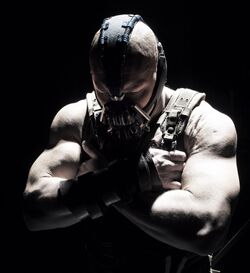
Let us speak first of Bane. Christopher Nolan has spoken before of his fondness for Bond films (a ski sequence in Inception hearkened back to On Her Majesty's Secret Service as well as The World is Not Enough). I caught many shades of Renard from The World is Not Enough in his character, though Bane has a much better and poignant backstory than his Bond counterpart. Unlike the Joker, Bane has a plan, a backstory, and feelings. He is scary. The fantastic opening scene shows us just what this man is capable of. He is a mirror for Batman, but he has not lost sight of himself and his purpose like Batman has. Which leads us to what I think the key of the film is, Bruce's hubris. He became legend, and then left at the top of his game in what he thought was a noble lie. Now he thinks he can just step back into it. He completely underestimates Bane, and opens himself up to all sorts of manipulation due to his own pride and apathy. In fact, every bad thing that happens in this movie is a result of his own disengagement with the world. His hubris, his lies, and his foolishness result in his punishment. Throughout the series, we've seen him trained by evil only to then take the tools of evil and attempt to use them for good. He then lies to the people to save them. As Bane says, "you put on the darkness. I was born in it." Batman's tricks do not work on Bane. Bane does not fear the dark knight. It is only after suffering a horrible penance that he can regain the conviction and strength of character necessary to truly save Gotham and finally be free.

 AnneHathaway's Selina Kyle is a compelling character. From the beginning, Bruce sees something different in her. Yet even here he is vulnerable to hubris. Many parts of this film feel closer to the comics than either of the previous two installments. Not so much in tone, but visually. Nolan eschews some of the complete realism he embraced in The Dark Knight in exchange for something more visually operatic. Even the conclusion of the film is far more bombastic than anything we saw in The Dark Knight. As I compared this to the Star Wars trilogy, the first and third films have Death Stars. While the microwave gun itself does not make a reappearance from Batman Begins, a super weapon unwittingly built by Wayne Enterprises does play a part, and again is part of Bruce's detachment and apathy. When he was actively involved during the time of The Dark Knight, Wayne Enterprises didn't make such silly things.

This is not the triumphant third installment one would expect. Unlike the previous two films, which largely stood on their own, this one relies heavily on the others for its emotional punch. It feels most like "an installment," mostly I assume because of the long time jump. There is a lot of ground lost between the second two films, whereas the first two bridged seamlessly. Yet, at the same time, it feels almost like a direct sequel to Batman Begins, with the events of The Dark Knight sort of tossed into the middle. As you can tell, I am still processing the movie.

This is not The Dark Knight. This is not more of same. This is a completely new and different beast. Batman Begins could be compared to the first Superman. The Dark Knight was Heat on steroids. The Dark Knight Rises defies comparison. I need to see it again.


Click here for more movie reviews.

Thursday, July 19, 2012

The Dark Knight: The Descent

The word that best describes the The Dark Knight is in the title, "dark." Even though Batman Begins is not a "light" film and has less scenes taking place in daylight than The Dark Knight has; it is much lighter in tone, and grounded in optimism. Batman believes his existence will lead to a brighter future for Gotham. The events of The Dark Knight threaten to prove him wrong.

If it wasn't already clear in Batman Begins, director Christopher Nolan intends Gotham to be a representation of our world. Not our planet, necessarily, but the space we live and breath in. If Gotham were a real city, people would just leave it and go elsewhere where they don't have killer clowns and scary scarecrows. But you can't escape Gotham. When characters like Lau leave it for Hong Kong, or when Bruce journeys to the Himalayas in Batman Begins, the places they go are symbols for things beyond our world. Perhaps even corresponding to the supernatural. Batman trains in Valhalla only to discover it is closer to purgatory. In The Dark Knight, he goes to the depths of hell to bring back Lau so he can face justice. These journeys have mythic significance.

Understood in this light, then, the battle for the soul of Gotham becomes the battle for our collective human soul. And the enemies presented begin to strongly resemble the demonic. When I first saw the film in 2008, I said that the Joker is the most complete and accurate depiction of the devil ever put on film. Satan knows that ultimately he cannot defeat God, so he wants to cause as much destruction and suffering as possible on his way down. He just wants to "watch the world burn." He even calls his struggle with Batman an eternal one; something I think the filmmakers would have explored further had not Heath Ledger's untimely demise occurred shortly before the film's debut.

Batman's answer to Gotham's (hence, the world's) problems is extremism. He goes to the extreme to solves the problem.  He flies across the world to bring back Lau. He knocks out Harvey Dent and hides him in a closet to keep him from attempting to fight the Joker. He throws Moroni off the roof. He bugs the entire city to find the Joker. The genius of the Joker is his willingness to match Batman point for point and try to force him over the edge. One could argue he comes very close to success. So close Batman can't recover.

But Batman has moral rules. Which, once his enemies see them, neuter the power of his extremism. Because he has limits. His technology can fail. His plans can be foiled. He can be defeated. Alfred says know your limits. Bruce says Batman has no limits. Alfred says he does and Bruce says he can't afford to know them.

What's scary is as far as he was pushed in The Dark Knight, The Dark Knight Rises threatens to push him even further. How much more can he take?

The other side of this coin is Harvey Dent. Dent is the "White Knight" as opposed to Batman's Dark Knight. Dent prosecutes the mob without fear. And when Batman is willing to bend to the Joker's demands to save the innocent, Dent decides to sacrifice himself instead. To take Batman's "sins" on himself and allow himself to be used as bait for the Joker. But his victory is short lived. His attempt at self-sacrifice ends in his ultimate loss. Like many great fallen men before him, he can't take it. The descent of Harvey Dent is probably the most poignant and realistic thing in the film. Unlike Batman, Dent cannot endure the loss of his love. He insists that "the only morality in a chaotic world is chance." He cannot accept that the rain falls on both the just and the unjust. His story echoes that of Horatio Spafford, who endured so much throughout his life, but finally succumbed to despair at the end. Or as Dr. Crane would say in Batman Begins, "The mind can only take so much."

Yet in the end, Batman believes that this man is the true symbol of hope that the people need, and that a lie, a noble lie, is the best way to preserve that symbol; to make Dent incorruptible. Batman takes on himself all of Dent's sins. This is a messianic act, but it is also a deliberate lie. For unlike Christ who comes and says "I have taken all of your sins upon myself," Batman says "Dent was not the sinner, I am the sinner." A lie cannot bring true salvation. Which is why the ending of The Dark Knight is unsettling, and necessitates a proper conclusion.

All these things, along with fantastic production value and extreme verisimilitude easily makes The Dark Knight one of the best and most definitive comic book films ever made. It is The Empire Strikes Back for our generation. Yet while Nolan definitely hearkens back to the first Star Wars trilogy in The Dark Knight, his conclusion promises to revisit the second Star Wars trilogy, in that the final installment promises to be be darker, and perhaps more fulfilling, than any of the preceding ones.

The Dark Knight Rises opens in theaters tonight at midnight.


Check back tomorrow for our in-depth review.
Check out Jeremiah's review of Batman Begins.

Click here for more movie reviews.

Wednesday, July 18, 2012

Batman Begins: Birth of a Hero

Some people are snobs. They assume because a story is told in a movie theater is only entertainment and/or action. I completely disagree. Some of the greatest works of literature were penned for the stage. If Shakespeare’s plays can go down in history as great literature, I believe that there are some movies that deserve a place in the same category. One of those is Batman Begins.

This story grabs your attention with incredible action and cool gadgets, but more important than that, the dialogue, characters, and story not only delve into the soul but also unravel part of the Gordian Knot of human struggles.

Batman Begins, at its core, is a movie about Bruce Wayne. No other Batman movie has come half as close to being a story about the title character. Like It’s a Wonderful Life, we walk with the lead from his childhood to his young adult life and finally into the fullness of Batman.


As we walk with him we discover the same lessons that he learns. We learn that fear is something that we must all face. We learn that life is hard, but we have a choice as to what we are going to do with it. We also learn with Bruce that mercy is what defines good from bad.

As I watched the movie again last night I was reminded of why this movie is so powerful. When Bruce Wayne is struggling with understanding who is to blame for his parents murder, he struggles with guilt because he was the one who asks them to leave early exiting the building into a quiet alley. But Alfred reminds him that the killer is the only one to blame. Then later Henri Ducard (the movie’s dark Obi-Wan Kenobi) tries to coldly blame the deaths on Bruce’s father for failing to protect his wife. Finally, Bruce is forced to face someone who round claims 
about credit for their deaths by causing the economic downfall of the city. This was a deliberate action done in hope of creating people like the murderer to tear the city apart.

Because of its nuance, complexity, and realism (an uncommon description for a Super Hero movie), Batman Begins redefines the “character origins” film. Clearly the entire story is about the beginning of Batman, but what makes it amazing is the little things like the incredible supporting characters. 

Michael Caine is inspired as Alfred, the wise support that seems to hold the Bruce Wayne’s world together. The other characters Rachel Dawes, Lucius Fox, Jim Gordan, and even the homeless Russian play key roles in Bruce’s life making him better and inspiring him to fight for true justice. 

These supporting characters stand in sharp contrast with the bad guys who also each play a key role in making Batman who he is. First there is Falcone, a mob boss who “owns the town.” He shows Batman power that money cannot buy and that corruption obscures justice, sending Bruce into a tailspin leading him to a prison in Asia. Then we have Dr. Crane, who says “I respect the mind's power over the body. It's why I do what I do.” In a real way he is the linchpin of the plot against the city. He is no match for Batman’s strength but his mask and weaponized drugs disable Batman for two painful days. Dr. Crane is someone that isn’t beaten by power or strength. That is a new lesson one for Batman, that he must learn because strength is not enough to save the city. 


Now, let’s talk about Henri Ducard. He cannot be fully placed with the villains who stand in Bruce’s way or with the supporting characters who build him up to be the hero he needs to be. I mentioned it earlier that he is a dark Obi-Wan Kenobi character. He finds our hero and takes him in. Ducard trains Bruce giving him the skills he needs to fight evil. He reinforces Bruce’s desire to see justice and helps him to face his fears. But it is all because he wants to use the Prince of Gotham to take down the city.

Ducard is complex and clearly hides behind many layers of deception and is driven by a desire for revenge that he perversely conflates with justice. He is a mentor whose training is not lost on his prize student. In the end, however, when the choice comes Bruce chooses to reject his master's plan and returns home having learned a new lesson: justice must be carried out in the right way and through the right channel.

Batman Begins is the new standard for origin stories. It pulls you from the very roots of what makes the hero who he is into the relationships that shape him. Finally it launches you into a world where the person the hero has become is able to overcome and turn back evil.

Post by Jeremiah Lorrig

Check back tomorrow for Daniel’s retrospective review of The Dark Knight.
Check back Friday for our review of The Dark Knight Rises.


The Dark Knight Rises opens in theaters everywhere Friday, July 20th.


Click here for more movie reviews.

Monday, July 2, 2012

The Glory of Heroes!


I don’t know if I’m the only one, but whatever I read impacts me.  Maybe it’s because I have an overactive imagination. But when I read about mysteries, I begin to notice potential “clues” in the details of everyday life. When I read about great leaders from the past, I start seeing the seeds of greatness in those around me. And when I read about ancient Greeks (like I am right now, in the Iliad), I think about glory.

The Iliad should be subtitled “101 ways to kill someone with a spear,” but if you hack your way through the action scenes, you can become acquainted with some of the characters. As you get to know them you discover that they are driven by a very powerful force: they live and die for glory.

Our culture has largely lost the meaning of “glory.” Today the closest thing we really have is “fame” or “popularity.” But glory goes deeper than these things. Glory is not something that happens because you are well known; glory is something that you must earn. It is something that makes you worthy of honor. Glory is the thing that urges people to tell and listen to stories about the greatness and worthiness of your deeds. It is something that, quite frankly, most of us would shy away from because we feel that we do not deserve such high praise.

Christians know that God is worthy of glory. He is good enough for it. We, by comparison, are nothing. So many people reason that God alone should have glory.

The heroes of Greek mythology were proud. They saw glory as something worth attaining. They fought and died for it. Because of glory, they would get up and fight on even when they were bleeding out in a losing battle. These heroes would turn the tide of wars! They would conquer unspeakable beasts. And, at times, they would even take on the immortals. Many of these heroes were inspired to lofty deeds because they believed that they had the blood of the gods in them. They thought they could win great glory because they were the children of the gods. Something about this struck me as I was reading today.

As Christians, we are sustained by the blood of the one true God; we’ve been adopted into God’s own family. That’s more powerful than being the son of Zeus! Because we are children of God, we can gain glory for His name. We have the ability to overcome huge obstacles. We can defeat the enemy by the power of His name. We can battle not only against flesh and blood, but also against principalities and powers. (How cool is that?)

Unlike the Greeks, I have to remember that God is the source of every good thing I do and that the glory belongs to Him. The Greeks, however, foreshadowed the truth. I am a son of God. Because of that, I am expected to be a hero and win glory for His name! Like the Greek gods did for their children in the Iliad, my Heavenly Father gives me strength, protects me, and even fights for me on occasion. Only He does it a whole lot better than Zeus or Poseidon ever could.

We live in days of excitement and challenge. But we need to take of the metaphorical spear into hand and boldly face the challenges of our day. Who knows? Maybe 1,000 years from now someone will be inspired by you, because you were a champion from the days when heroes won glory for His name!

Post by Jeremiah Lorrig  

Wednesday, June 13, 2012

Clinton, Bush, and character archetypes.

Upon the recommendation of multiple friends, I recently began Tony Blair’s autobiography (if anyone is interested, the audio version is also very good - Blair reads it himself). It is full of sound political advice, which Blair drops casually into his narrative. But in the introduction, Blair describes working with both Bill Clinton and George W. Bush.

Bill is an extraordinary mixture of easygoing charm and ferocious intellectual capacity. Probably, in terms of political intuition and certainly in terms of turning such intuition into analysis, he is the most formidable politician I ever met. My theory is that, in a curious way, the blessing of his times is the disadvantage of his legacy. As with any period, the years 1993-2000 were full of events, many of them hugely significant, But the world-changing events--9/11 and the financial crisis--happened in the next presidency.

Bill was actually a brilliant president. He made it at times look easy. He ran a good economy; made big reforms; handled, as I will relate, Kosovo with real leadership. But it is fascinating to speculate how he would have handled later world-changing events. There neither charm nor intellect would have been sufficient. It would have been pure calibre that determined the outcome. I believe he would have had it.

George W. Bush was straightforward and direct. The stupidest misconception was that he was stupid. He also had (has) great intuition. But his intuition was less--as in the case of Bill--about politics and more about what he thought was right or wrong. This wasn’t expressed analytically or intellectually. It was just stated. At times--since I was more from the Clinton school--I would find this puzzling, even alarming. I would be at a press conference with him, in the epicentre of those world-changing events, and I would think “George, explain it; don’t just say it.”

However, over time, and more even in retrospect as events have continued to unfold since I left, I have come to admire the simplicity, the directness, almost the boldness of it, finding in itn strength and integrity. sometimes, in the very process of reasoning, we lose sight of the need for a destination, for finding the way out of the labyrinth to solid ground that stands the test not of a few weeks, months or even a year or two, but of the vastness of the judgement of history.

I read that and suddenly realized that I’ve seen that personality contrast before. Recently, in fact. One character, a little awkward but with a deep black and white moral sense of justice that feels out of place, meets the epitome of the modern man, brilliant, tactical, ruthless, and charismatic.

Steve Rogers meets Tony Stark.

Think about it, it works. Startlingly well.


Photo credit: Marvel
Photo credit: AP


Friday, May 25, 2012

"The Avengers": An Unprecedented Moment in Film Series History

(Photo Courtesy of www.avclub.com)
The release of "Marvel's 'The Avengers'" (a title within a title) signals the culmination of a long gestating plan to redefine the way big budget franchises are made and take Hollywood back a step toward something resembling the old studio system. Marvel, a comic book company, has been heavily involved in the movie business since 2000, when Brian Singer's excellent "X-Men" film relaunched the comic book genre after it crashed and burned throughout the 90's. The genre had seemed like it would never recover after 1997's "Batman and Robin." Singer proved there was still gold to be mined there, however, and began the "superhero" film craze that swept the U.S. in the early- and mid-aughts, displacing the anticipated kings of the decade like the Star Wars prequels, Mission: Impossible and James Bond films (the latter two having made more recent comebacks after a little superhero fatigue).

But a line can be drawn between 2007 and 2008. 2007 saw the abysmal "Spiderman 3" and the end of an era as America collectively realized such films no longer held any value. 2008 saw the release of "Iron Man" a film that eschewed the usual "secret identity" tropes and allowed itself to revel in its own absurdity while never becoming truly absurd. In this film we were introduced to "Tony Stark," the perfect, sarcastic, wisecracking, and slightly amoral antihero custom built for modern America. Yet over the course of the film he learns the value of honor and courage and begins a transformation. Whether it was the fun, light tone, or the action, or the superb performance from Robert Downey Jr., America embraced the film without reservation, making it a bona fide hit.

Marvel must have anticipated this success, because they decided to include a post credit teaser that changed how we perceive comic book films. I have been told that the character of Nick Fury was originally a white guy, but was redesigned in the 90s to a template based on Samuel L. Jackson. So it was fitting to have Jackson play the character at the end of the film and to have him utter two words that would send comic book lovers into a tizzy: "Avengers Initiative."

Even I, ignorant of all Marvel comics and their back-story, knew that "The Avengers" was a group of super heroes, somewhat like the Justice League, and as I heard more I realized that it was made of all the superheroes that I assumed would never get modern movies. "Hulk" had already flopped, and I never thought that "Captain America" or especially "Thor" would be source material for films that would be embraced by the American public. I was wrong.

"Thor" and "Captain America" were very successful at the box office, with Thor playing especially well overseas. Perhaps anticipating this success, Walt Disney Studios decided to gamble on Marvel's groundbreaking concept and purchased the company for $4 billion in 2009. Their vote of confidence should have been an early warning sign that film and the entertainment industry was about to change.

Both "Thor" and "Captain America" were directed by filmmakers of great pedigree, yet to the unit intimated viewer (such as myself) both were slightly unsatisfying. Having seen "The Avengers," I went back and rewatched both films as well as Iron Man 2, and I realized that all my problems with the films had disappeared. In an odd way, starting with Iron Man 2, Marvel had been producing the prequels first. This meant that each film was slightly unsatisfying on its own, but it was as if they knew that once "The Avengers" had been released, the entire tapestry would make sense.

This sort of continuous storytelling has never been attempted before on screen. In the space of 4 years, Marvel has released and connected 6 films in continuity with each other. Few great franchises can claim this. It took Star Wars over 30 years, Star Trek 12, and most other franchises have been content with trilogies. But audiences love continuity in their media. Perhaps it compensates for the lack of real connection in our modern lives that we feel a need and desire to connect with and follow the lives of fictional characters.

Nonetheless, the Avengers and the series of films that spawned them have rejuvenated comic book films and ensured their survival into the next decade in several ways. They have transformed a genre known for repetitive hijinks into a science-fiction heavy epic that coincides along with our own history and reality (Captain America is a great example of this). They have created larger than life heroes who don't require secret identities or glasses or strange afflictions to exist in our world; regular characters simply accept the existence of giant green monitors or Asgard or super soldiers. Tony Stark ended the war on terror. By watching normal people on screen accept this, it allows us to accept it too.

But what really sells it and draws us in is the length and breadth of the material. Christopher Nolan created an immersive Batman series in 2005, and 7 years later we await installment 3. Marvel produced 6 movies in 4 years. None of which are anywhere near the masterpieces of Nolan, yet equally as successful and engaging. In a time when franchise films get harder and harder to produce, and release dates farther apart (a four year wait between sequels used to be an aberration; now it is an accepted necessity as filmmakers expect time to produce other films in the interim), it is refreshing to get a high quality series from a diverse pool of talent getting released at regular intervals. Perhaps the secret of getting people back to the movies again in a world of instant gratification is to make movies faster. We make them bigger, flashier, edgier, but we are making them slower. Technology should allow films to be made faster and cheaper. There is also a dearth of "accepted" filmmaking talent, created by the slowing pace of film production.

Filmed entertainment is here to stay; but it doesn't have to stay stale. "The Avengers Initiative" (what I'll call Marvel's great experiment), is a bold move that aims to challenge the status quo (casting largely b-list actors and making them stars is something that hasn't really been done since the 1970's) and promises great things for the future of the medium.

Note: you can read Jeremiah's review of The Avengers here.

Click here for more movie reviews.

Tuesday, April 12, 2011

The importance of orcs

There are two novels that can change a bookish fourteen-year old’s life: The Lord of the Rings and Atlas Shrugged. One is a childish fantasy that often engenders a lifelong obsession with its unbelievable heroes, leading to an emotionally stunted, socially crippled adulthood, unable to deal with the real world. The other, of course, involves orcs.


I have been reminded of this quote multiple times over the past few weeks, partly because both Tolkien and Ayn Rand have been the subject of recent articles I have read.

Over at Touchstone, Anthony Esolen writes that "When my daughter was young, she would often be asked, not usually by fellow homeschoolers, why she kept reading The Lord of the Rings. I told her to reply, 'Because I want to know what's going on in the world.'"

A similar argument was recently made by Mark Mitchell (my philosophy professor) about Jane Austin: "Austen reminds us of the largely forgotten categories of the lady and the gentlemen. It is her genius to make us aspire to these roles even in a world where such notions are strange and often ridiculed."

Reality, honor, family - that is what these stories give us.

Ayn Rand, on the other hand, has no room for such concepts, as poignantly and painfully demonstrated in a recent Salon article entitled "How Ayn Rand Ruined My Childhood."
From what I understood of [my father's] favorite capitalist champion, any form of altruism was evil. But how could that kind of blanket self-interest extend to his own children, the people he was legally and morally bound to take care of? What was I supposed to do, fend for myself?

The answer to my question came on an autumn weekend during my sophomore year in high school. . . . [My dad] and his new wife sat me down at the dinner table with grave faces.

"We were wondering if you would petition to be emancipated," he said in his lawyer voice.

"What does that mean?" I asked, picking at the mauve paint on my hands. I later discovered that for most kids, declaring emancipation is an extreme measure -- something you do if your parents are crack addicts or deadbeats.

"You would need to become financially independent," he said. "You could work for me at my law firm and pay rent to live here."

This was my moment of truth as an objectivist. If I believed in the glory of the individual, I would've signed the petition papers then and there. But as much as Rand's novels had taught me to believe in meritocracy, they had not prepared me to go it alone financially and emotionally. I began to cry and refused.
For Rand's world, unlike Tolkien's or Austin's, is surprisingly unreal. As Whittaker Chambers notices in his review of Rand:
Yet from the impromptu and surprisingly gymnastic matings of the heroine and three of the heroes, no children — it suddenly strikes you — ever result. The possibility is never entertained. And, indeed, the strenuously sterile world of Atlas Shrugged is scarcely a place for children. You speculate that, in life, children probably irk the author and may make her uneasy.
Rand's world stands alone, disconnected by the past (the elderly) or the future (children). Nor is she dependent on anyone (dependence, for Rand, is evil), as Chambers notes "Miss Rand acknowledges a grudging debt to one, and only one, earlier philosopher: Aristotle." Chambers then continues to assert that Rand owes more to Friedrich Nietzsche than to Aristotle.

In contrast to the classics, which address truth and beauty and good and evil, Rand merely has weak and strong, dependent and independent. Not knowing real self-sacrificing good, she is unable to write about real evil, and her characters are reduced to caricatures. If only they had to face some orcs, then we could truly judge their worth.
Related Posts Plugin for WordPress, Blogger...