Thursday, December 20, 2012

The Hobbit: An Unexpected Pleasure - Review (Part II)

"I did not give you that map and key so that you could cling to the past." I loved The Hobbit: The Unexpected Journey. I saw the film in 3D (conventional 3D, so there will be no discussion of the controversial 48 Frames Per Second issue here) and found it quite beautiful and immersive. Having seen it again since in 2D, I will say that I felt my eye actually had more to see in the 3D version, and so the film seems edited to favor the 3D experience, which makes sense, considering it was filmed in native 3D using 2 very high definition cameras.

Spoilers for The Hobbit: An Unexpected Journey follow:

The film is a very fun adventure story, and so very unique in our time. It is based on a third of a book, though I think it would be more accurate to say it is based on a third of a story. Tolkien wrote the entire history of Middle Earth in his books, and this film takes as its inspiration events during this time in that history, not limited solely to events written in The Hobbit itself. It may come as a surprise to many casual book fans that most of the "additional" material presented is not made up; no characters were introduced that do not appear elsewhere in Tolkien's writing, and character histories are, for the most part, respected. Scenes such as the battle outside Moria and the Necromancer are almost entirely lifted from other Tolkien writings, and I think they are well used here. As a child, I was very interested in the Necromancer and Dol Guldor, which Tolkien only briefly references in the book, and am very interested to see Benedict Cumberbatch (of Sherlock fame) play this pre-incarnate version of (spoiler!) Sauron. Since no comprehensive account of this battle between Gandalf and the weaker Sauron exists, this could be quite interesting, especially since, in The Lord of the Rings, Gandalf is clearly afraid of his enemy, and considers him now beyond his skill. (Part of me also hopes the Witch King of Angmar gets his own HBO show, as his history is further hinted at here, and there is enough payoff in The Return of the King to justify a little more of it in the next film). This aspect of the trilogy's plot, which I thought was well set up in this installment, has me the most intrigued, because it is the most original part of the films, and I am curious to see what happens.


I was also pleased at the inclusion of Radagast the Brown Wizard, and shocked and delighted by his depiction. He was actually featured in The Fellowship of the Ring, but removed from the film version. He really gets his moment to shine here though, and I hope we have not seen the last of him. I found the moments of absurdity in the film, such as his rabbit sled, very entertaining. I also enjoyed the depiction of his (and Gandalf's powers) in the film, which are more robust than in The Lord of the Rings. I look forward to the battles between the wizards and the Necromancer; I wonder if Radagast will face death (since he is not in Lord of the Rings, and even in the books, I thought he might be useful), and if Saruman will be guilty of any sort of early treachery. I'd also like to praise their efforts in executing Christoper Lee's return, as his health precluded any trips to New Zealand. They were able to film his dialog on a green-screen set in London, built to match the dimensions of their set in Wellington. I'm not sure if he and McKellen were ever in the same room, but their chemistry was trans-continental.

Speaking of which, this was Gandalf's movie. Ian McKellen gets top billing for the first time (does this make him eligible for Best Actor?) and he earns it. He glides through this film, firmly rooting it and just making it awesome. Gandalf really is, as Saruman calls him, a "meddler," and is orchestrating this whole situation to a purpose. The interplay between these great "guardians of Middle Earth," sent by divine powers is fascinating. I was also struck that of all the wizards, he is the one running around on catwalks with a sword, cutting great goblins to bits, and force pushing orcs into oblivion. It's a very active life for a wizard in any franchise.

I also appreciated the structure of the film itself. Many more critical of the film than I (including some in my family), found the film boring. The film does spend quite a bit of time in Bag End, toward the beginning. This is because the whole sequence is largely preserved as Tolkien wrote it. This sequence is his true introduction to Middle Earth, and if at some point anyone watches these films starting with The Hobbit, that scene will be crucial. It's the slow introduction to fantasy that often works well with first installments; the original Star Wars is structured similarly. It also lets us feel Bilbo's reluctance. If he is off on his adventure in the first ten minutes, we might be tempted to believe this is ordinary in Middle Earth. But the time it takes to convince him proves it is not. In this way, the film becomes a strong character piece for the titular hobbit. They then do begin their journey, pursued by Orcs. I do wonder if Gandalf's question, "who did you tell?", will get answered in future films. We are not given the answer, but I do wonder if the dwarves have a traitor in their midst? Azog the Goblin, played via motion capture by Manu Bennett, is a formidable opponent. I guess what I really liked about him was he is different from the other Orcs we have seen, more wild, and dangerous. CGI characters do not generally bother me in fantasy films, as I don't find a man with makeup and plastic on his face to be more convincing. Azog is sort of the General Grievous of the movie, and I liked Grievous just fine. Same goes for the Great Goblin himself, who reminded me of Jabba the Hutt, in the best way possible. The Lord of the Rings featured many villains, but none of them were particularly comical, and I enjoyed the change. I also really liked the goblin messenger, who reminded me of Jabba's court jester in Return of the Jedi, also in the best way possible. I enjoyed the structure of the film, featuring set up, light action, then rollicking Indiana Jones style action (Goblin town felt like a very 21st century Temple of Doom) leading into the finale. Much like they did with The Fellowship of the Ring, they were able to craft an ending to the first installment that felt both like an end to this part of the story and also teased what was to come. I am excited for the audiences to see what happens next as the worst is definitely not behind them.
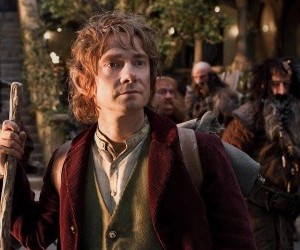
Of course, the MVP in all this is Martin Freeman as Bilbo. When he was first shown on screen I instantly thought that he was more like Bilbo than Ian Holm was. Peter Jackson is not George Lucas; as such he creates minor inconsistencies as he goes and ignores them. In Fellowship, Gandalf says Bilbo hasn't aged a day. He clearly has. Of course, in Fellowship, Gollum is black skinned with yellow eyes, so visual continuity is not paramount in this series, and I was ok with that, because I felt this film was true to itself; in particular, this Bilbo is true to himself.

Freeman plays every aspect of this character at once, creating a beautiful inner conflict that is a joy to watch. He is at once out of his element and yet embracing his new element as best as any normal person could. He takes to fighting in a way which we never saw Frodo, which makes him the coolest uncle you could ever have. He is also quintessentially British. Elijah Wood and Sean Astin were both Americans, feigning accents. Of the original four hobbits, only Dominic Monaghan was actually British. So, there is a certain restraint in Freeman's performance that I don't believe we saw in any of the hobbits in the previous three films. In that way, he brings real humanity to a role that could have easily been played as a very over-the-top caricature.  His groundedness allows us to enjoy the other, more fantastical aspects of the film.

I highly recommend this film if you enjoy fun, entertaining movies. If you hate fun, comedy, CGI, or good british actors, don't go see this movie. I for one love all of the above.

Update: I've since seen the film in 48 frames-per-second, and while I do now believe that 3D is the best way to view this film, I found the seemingly accelerated motion distracting and detracting from certain strong actor performance moments I noticed at the standard speed.

Click for part 3 of my review, "The Relevance of the Hobbit Today,"
Or, go back to Part I.

Click here for more movie reviews.

Wednesday, December 19, 2012

The Hobbit: An Unexpected Journey - Review (Part I)

There is a disturbing trend happening with major movie releases these days. According to critics (and many audience members), a new film is either an amazingly surprising hit, or it is a disappointment. This verdict can almost be completely pre-determined by the collective expectations preceding the film's release. With almost no films budgeted over $100 million based on original material, all major releases are either sequels (or prequels, which are still actually sequels) or based on other media such as books, tv shows, comic book characters, or, rarely, plays; which means that each has dedicated fans who have very ingrained pre-conceived notions about what their favorite thing is really all about.

Calypso and Assante from
"The Odyssey" (1997)
Before 2001, this was why most successful works of fiction were not made into films. The conventional wisdom was that film adaptations could not do major works of fiction justice. One only has to watch the Armand Assante version of The Odyssey or the BBC productions of The Chronicles of Narnia to see that this is true. Even most comic book films of the period were dismal both in their quality and in their ability to translate what millions loved into something that worked on the screen.

But The Lord of the Rings: The Fellowship of the Ring (2001) changed all of this. A hit with fans of the book and general audiences alike, this film opened the door to what has become a decade of, well, unoriginality at the movies. So, in 2012, the tentpole releases were The Avengers (sixth in a series), The Dark Knight Rises (third, or seventh, or eighth, depending on how you count), The Bourne Legacy (fourth), Skyfall (23rd), and now The Hobbit: An Unexpected Journey. With The Avengers, many doubted that anyone could make a film with so many super heroes in it work. They were pleasantly surprised that it did work and so one of the slimmest plotted films of the year went down as one of its best. Whereas the critics were expecting the second coming of Christ with The Dark Knight Rises, and instead greeted it with indifference, perhaps not liking so much what it had to say.


A similar phenomenon occurred with The Hobbit: An Unexpected Journey in that The Lord of the Rings Trilogy is one of the few films of the last decade everyone can admit to liking without drawing looks of disgust from one corner of the room. So, many in the media were looking forward to experiencing a new revelation in cinema. Suffice to say they did not. Nor should they have.

Tolkien's The Fellowship of the Ring is arguably his greatest single work. The amount of character development and pathos in that book is unmatched in his other writings. If you've read The Silmarillion, you know he actually writes in a very distant, objective style. This is actually one of the reasons The Hobbit is such a short book, page count wise. The stone giant sequence in the film that has been criticized by many is straight from the book, but it only occupies one sentence. It is not described. But in those days, people weren't as critical (or so it would seem), and this was not considered a problem. When translating such a story to film, where things are shown, and not told, one cannot avoid depicting such a fantastic sight. Tolkien's writing is full of such little asides and tangents that are irrelevant to the overall plot but essential to the atmosphere of his fairy tale world.

Daniel Craig in "Skyfall"
The Hobbit simply isn't as strong a book as The Fellowship of the Ring; however, it's a great book. It's a funny book, a moving book, a (melo)dramatic book, and a wonderful story. But it is different; and movie goers (and especially critics) don't like "different." They say they do; they will say "this film breaks new ground," or it "defies the stereotype," but it actually doesn't. Skyfall earned a lot of praise for being a "different" kind of Bond film; when in reality, it simply wasn't a Bond film. Had that same film been made under a different name or with a different character, it would not have merited their notice, because it is exactly like every other action film of the past five years. It is in essence not "different," but in line with the styles of the time; this dark, "ultra-real," "gritty," aesthetic that is currently in vogue, where no CGI is used and lots of people die horrifying deaths. In Skyfall, our "hero" saves no one, and does nothing remotely heroic. This was loved by the critics of our day. "The Hobbit: An Unexpected Journey" does not fall in line with this aesthetic, and therefore has not earned their favor.

Continue on to Part II - An Unexpected Pleasure.
Or skip to Part III - The Relevance of the Hobbit Today.


Click here for more movie reviews.

Friday, December 14, 2012

Pray for the Families in CT


As you know I oppose many things that Obama has done and stands for. But I stand with him today when he ordered flags at federal buildings to be flown at half staff. 

President Obama also said, "Our hearts are broken today for the parents and grandparents, sisters and brothers of these little children and for the families of the adults who were lost." He continued, "Our hearts are broken for the parents of the survivors as well, for as blessed as they are to have their children home tonight, they know that their children's innocence has been torn away from them too early and there is no way to ease their pain." 

Thank you Mr. President for speaking for America in a time of grief. 

Here is the text of the proclamation: 
As a mark of respect for the victims of the senseless acts of violence perpetrated on December 14, 2012, in Newtown, Connecticut, by the authority vested in me as President of  the United States by the Constitution and the laws of the United States of America, I hereby order that the flag of the United States shall be flown at half-staff at the White House  and upon all public buildings and grounds, at all military posts and naval stations, and on all naval vessels of the Federal Government in the District of Columbia and throughout the United States and its Territories and possessions until sunset, December 18, 2012. I also direct that the flag shall be flown at half-staff for the same length of time at all United States embassies, legations, consular offices, and other facilities abroad, including all military facilities and naval vessels and stations.IN WITNESS WHEREOF, I have hereunto set my hand this  fourteenth day of December, in the year of our Lord  two thousand twelve, and of the Independence of the  United States of America the two hundred and thirty-seventh.
Also from the House of Representatives:

WASHINGTON, DC – House Speaker John A. Boehner has issued the following statement regarding the shooting at Sandy Hook Elementary School in Newtown, CT:
“The horror of this day seems unbearable, but we will lock arms and unite as citizens, for that is how Americans rise above unspeakable evil.  Let us all come together in God’s grace to pray for the families of the victims, that they may find some comfort and peace amid such suffering.  Let us give thanks for all those who helped get people to safety, and take heart from their example.  The House of Representatives – like every American – stands ready to assist the people of Newtown, Connecticut.”

NOTE: Speaker Boehner has ordered flags over the United States Capitol to be lowered to half-staff in honor of the victims of this tragedy.

Post by Jeremiah Lorrig

Friday miscellaneous (12/14)

Because I am in the middle of law school final exams this week, there will be no Friday links. I hope to resume my regular Friday posts next week.

Rest assured, however, that finals are not preventing me from seeing The Hobbit tonight. So my priorities are, in fact, in order.

I do have a video, though. One of my co-bloggers sent this to me for finals inspiration (or something).


Tuesday, December 11, 2012

Are capitalism and communism related?

The first articles from John Medaille that I remember reading were his five part series on distributism. Since then, I’ve always learned something from his articles on the economy (whether I agree or not). This past week’s article was no different. In a speech entitled “Why Isn’t Romania Rich?”, Medaille goes far beyond Romania and discusses the “science” of economics as a whole:
[L]et me point to a curious parallel. In the last days of the tyrant’s reign, Ceauşescu starved his people to pay the foreign debt. Now, look at the situation in Europe today, and we find that the solution proposed for Greece is that she should starve her people to pay the foreign debt. That is to say, what Communism accomplished with tanks and the Securitate, finance capitalism accomplishes with bonds and bankers. 
* * * 
This leads us to note a curious parallel between the universalism of Marx and the globalism of the capitalists. For both, place and culture meant nothing; global capitalism, like international communism, knows no limits and recognizes no borders. Is it not fair to ask if Brussels is home to a Fourth Internationale, with lyrics provided by Goldman-Sachs, to a tune played on a cash register, and accompaniment by the unholy trinity of the World Bank, the WTO, and the European Central Bank? As the Marxist critic Slavoj Žižek, noted, “Socialism failed because it was ultimately a subspecies of capitalism…Marx’s notion of Communist society is itself the inherent capitalist fantasy.”
The parallels with this Fourth International and its crude predecessors can be startling. For example, the communists gathered production into vast collectives, conglomerates that shut down any competing source of production and political power, and concentrated effective ownership in the hands of the bureaucrats. But in the capitalist world, production is gathered into vast conglomerates, which are collectives which shut down any competing source of production and political power, and concentrate effective ownership in the hands of the bureaucrats. 
* * * 
The attempt to eliminate ethics from economics created a world that was devoid of both social justice and economic order. Having abandoned any objective standards of truth and justice, there was simply no way to resolve the disputes between the contending views, which now became, not science, but pure ideologies. Lacking any recognition of some common good, the only way to resolve disputes between the contending schools of thought was by violence, and as ideologies became nationalized, ideology meant war. It is no accident that the 20th century, the most ideological century in history, was also the bloodiest century in history. 
* * * 
What is needed is new thinking, by which I mean old thinking—that is, ancient truths—applied to new situations. I think it is time to end the 20th century’s disastrous experiment with economics as a pure science and return to the older idea of political economy as a humane science. There are three things that differentiate political economy from economics, and they are justice, purpose, and property. Justice (taken here as an economic notion) is necessary for the proper balance of supply and demand; a stated purpose is necessary to be able to reach a judgment about economic systems; and property is the most basic of all economic relationships.
The entire thing is worth reading, especially for anyone interested in economic thought.

Sunday, December 9, 2012

Christmas is for the needy (Second Sunday in Advent)

According to the church calendar, the four weeks leading into Christmas are known as the season of Advent. Today marks the beginning of the second week of that season. It is not Christmas, but instead is a time for Christians to prepare for the birth of the Savior. It is a time of waiting, which makes the Christmas season so much sweeter. In the words of one of my favorite Christmas carols:

Long lay the world in sin and error pining,
'Til He appear'd and the soul felt its worth.
A thrill of hope the weary world rejoices,
For yonder breaks a new and glorious morn.

Yet advent is not merely looking back. It is also looking forward; for just as the world waited Christ’s first coming, we are now awaiting his second.

* * *

Christmas is a happy and joyful season when we celebrate the birth of our Savior. But the original Christmas was far from joyful. In fact, it was quite the opposite.

Christ was born into political oppression.  The land was occupied by Rome, a foreign pagan power that had no rival. Their rulers were no longer appointed by God, but but by Caesar, a man who believed himself to be god. Adding insult to injury, Caesar had appointed Herod, a descendant of Esau, as the local ruler. All attempts at rebellion had ultimately been futile.

Christ was born into spiritual depression. Israel’s best days were behind it. The God who had led them out of Egypt and raised up David and Solomon had abandoned his people to foreign oppressors. His glory had departed the temple. The prophets had been silent for hundreds of years. The religious leaders were more focused on their own status then the needs of the people.

Christ was born in the world. A place that had been ravaged by the effects of sin for thousands of years. The chosen people were either scattered or oppressed. The local gods could not save, nations rose and fell, but little improved. Everything was futile.

But such was the perfect time for Christ’s incarnation. As he said himself: “Those who are well have no need of a physician, but those who are sick. I came not to call the righteous, but sinners.” (Mark 2:17)

Christ came not for the healthy, but the sick.

Christ came not for the satisfied, but for the needy.

Christ came not for the wise, but for the foolish.

Christ came not for the powerful, but for the weak.

Christ came not for the righteous, but for the sinners.

Christ came for those who need a savior. Which is all of us.
Related Posts Plugin for WordPress, Blogger...